Inizio Registrati Login

Elenco album Ultimi arrivi Ultimi commenti Più viste Più votate Preferiti Cerca

Inizio > SOLAR SYSTEM > Mercury
Ritorna alla pagina delle miniature FILE 143/248 Torna all'inizio Guarda foto precedente Guarda foto successiva Salta alla fine
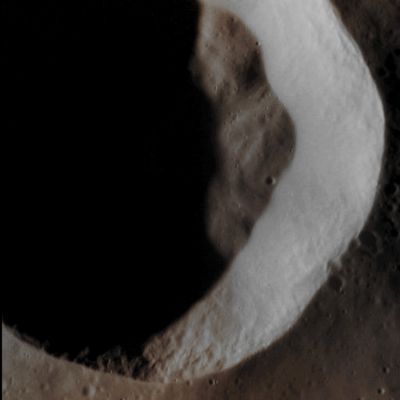
Unnamed Mercurian Crater (Absolute Natural Colors; credits for the research and the additional process.: Dr Paolo C. Fienga/Lunar Explorer Italia/Italian Planetary Foundation)
This dramatic image, where North is to the right, shows a Simple Impact Crater some 11 Km in diameter, located within the 290-Km-diameter Mendelssohn Basin. Its sharp Rim indicates that this Crater is a comparatively young Feature, though some parts of the Crater Walls have slumped (---> slowly fallen down) onto the Floor. The High Resolution of this image allows us to see quite a few distinctive textures along the Crater Walls.

Date acquired: July 21, 2012
Image Mission Elapsed Time (MET): 251400686
Image ID: 2244179
Instrument: Narrow Angle Camera (NAC) of the Mercury Dual Imaging System (MDIS)
Center Latitude: 70,28° North
Center Longitude: 105,38° East
Resolution: 19 meters/pixel
Scale: the field of view in this image is approx. 9,7 Km (such as about 2,3 miles) across
Solar Incidence Angle: 76,9° (menaing that the Sun was about 13,1° above the imaged Local Horizon at the time that the picture was taken)
Emission Angle: 11,0°
Sun-Mercury-MESSENGER (or "Phase") Angle: 87,9°
Parole chiave: Mercury from orbit - Craters - Unnamed Crater

Unnamed Mercurian Crater (Absolute Natural Colors; credits for the research and the additional process.: Dr Paolo C. Fienga/Lunar Explorer Italia/Italian Planetary Foundation)

This dramatic image, where North is to the right, shows a Simple Impact Crater some 11 Km in diameter, located within the 290-Km-diameter Mendelssohn Basin. Its sharp Rim indicates that this Crater is a comparatively young Feature, though some parts of the Crater Walls have slumped (---> slowly fallen down) onto the Floor. The High Resolution of this image allows us to see quite a few distinctive textures along the Crater Walls.

Date acquired: July 21, 2012
Image Mission Elapsed Time (MET): 251400686
Image ID: 2244179
Instrument: Narrow Angle Camera (NAC) of the Mercury Dual Imaging System (MDIS)
Center Latitude: 70,28° North
Center Longitude: 105,38° East
Resolution: 19 meters/pixel
Scale: the field of view in this image is approx. 9,7 Km (such as about 2,3 miles) across
Solar Incidence Angle: 76,9° (menaing that the Sun was about 13,1° above the imaged Local Horizon at the time that the picture was taken)
Emission Angle: 11,0°
Sun-Mercury-MESSENGER (or "Phase") Angle: 87,9°

ZZ-Mercury-Craters-Tyagaraja_Crater-PIA17051-PCF-LXTT-IPF-2.jpg ZZ-Mercury-Craters-Unnamed_Crater-CP_and_Hollows-PIA16952-PCF-LXTT-IPF-1.jpg ZZ-Mercury-Craters-Unnamed_Crater-PIA16392-PCF-LXTT-IPF.jpg ZZ-Mercury-Craters-Unnamed_Crater-PIA16948-PCF-LXTT-IPF.jpg ZZ-Mercury-Craters-Unnamed_Crater-PIA17290-PCF-LXTT-IPF-0.jpg
Informazioni sul file
Nome del file:ZZ-Mercury-Craters-Unnamed_Crater-PIA16392-PCF-LXTT-IPF.jpg
Nome album:MareKromium / Mercury
Valutazione (5 voti):55555(Mostra dettagli)
Parole chiave:Mercury / from / orbit / - / Craters / - / Unnamed / Crater
Copyright:NASA/Johns Hopkins University Applied Physics Laboratory/Carnegie Institution of Washington and Dr Paolo C. Fienga/LXTT/IPF for the additional process. and color.
Dimensione del file:323 KiB
Data di inserimento:Ott 28, 2012
Dimensioni:3000 x 3000 pixels
Visualizzato:94 volte
URL:https://www.lunexit.it/gallery/displayimage.php?pid=30877
Preferiti:Aggiungi ai preferiti

Commento 1 a 3 di 3
Pagina: 1

MareKromium   [Ott 28, 2012 at 10:26 AM]
Una curiosità: molti dicono che, in fondo, tutti i Crateri da impatto sono uguali (il che, come sapete, non è affatto vero). Io Vi suggerisco, ripeto: a titolo di curiosità, di provare a confrontare questo Cratere Mercuriano Senza Nome con un altro Cratere (ma questa volta Lunare), visible nel frame Original Lunar Orbiter "LO2-61m-01" e poi di dirmi che ne pensate... (nota: per vedere meglio la, ritengo, straordinaria somiglianza esistente fra i due rilievi che ho citato, Vi suggerisco di scaricare ed affiancare i due frames, "riflettendo" quello che mostra il Cratere di Mercurio, così da poter apprezzare anche l'identica Geometria di Illuminazione - la quale gioca a favore della memoria di chi osserva ed aiuta, se volete, a mettere in relazione Rilievi lontanissimi sia nello Spazio, che nel Tempo...).

Buon Lavoro! paolo
Anakin   [Ott 29, 2012 at 09:01 AM]
Sono molto simili. Si potrebbe pensare allo stesso cratere visto da due diverse angolazioni, però chiedo: la luna e mercurio sono molto simili. Insieme hanno centinaia, se non migliaia, di crateri di varie dimensioni. Penso sia normale trovarne almeno una 20na molto simili se non quasi identici. O no?
paolocf1963   [Ott 29, 2012 at 07:58 PM]
Si Anakin, la mia era solo una curiosità. La Luna e Mercurio, effettivamente, sono stati sempre considerati "Corpi Celesti Gemelli". Ma, a mio umile parere, le differenze sono abissali. Il "tratto comune"? L'elevata craterizzazione. Ed ora sorge spontanea la domanda: come mai l'elevata craterizzazione è il "tratto comune" a questi due DIFFERENTISSIMI Corpi Celesti? ... Abbraccio Circolare - paolo

Commento 1 a 3 di 3
Pagina: 1


Powered by Coppermine Photo Gallery