Inizio Registrati Login

Elenco album Ultimi arrivi Ultimi commenti Più viste Più votate Preferiti Cerca

Inizio > SOLAR SYSTEM > Mercury
Ritorna alla pagina delle miniature FILE 55/248 Torna all'inizio Guarda foto precedente Guarda foto successiva Salta alla fine
In search of the "Vulcanoids"
In mid-February 2009, before and after MESSENGER's latest Perihelion (such as the closest approach to the Sun), an imaging campaign was conducted to search for "Vulcanoids": small rocky bodies that have been postulated to exist in orbits between Mercury and the Sun. Those images are still waiting to be transmitted to Earth. 
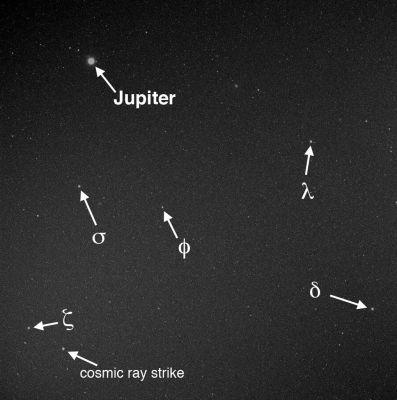
The image here is from the first set of 240 MDIS images taken to look for vulcanoids, acquired in June 2008. It is a 10" exposure taken through the WAC's clear filter. Jupiter is bright and visible in the image. The camera field of view is nearly large enough to capture the entire width of Sagittarius, a constellation of the Zodiac visible low and to the South in Summer from temperate latitudes in the Northern Hemisphere. The Greek letters identify some of the brighter stars in Sagittarius. 

During the Vulcanoid search campaign, 4-5 images of the same scene are taken back to back. This procedure allows Cosmic Ray strikes on the camera's detector to be identified and enables fainter objects to be detected. One such Cosmic Ray strike is labeled on this image. In this single image, the Cosmic Ray strike appears similar to the stars, but in the 4 images taken immediately after this one, the Cosmic Ray strike is gone whereas the stars remain. Images are also taken hours and days apart, so the motion of objects in the sky can be determined. If a Vulcanoid were imaged, its motion through the sky would appear very different from motions of the background stars and known Solar System objects. 
No Vulcanoids have been found yet, but the latest set of acquired images will expand the volume of the search region examined so far. 

Date Acquired: June 4, 2008
Image Mission Elapsed Time (MET): 121050477
Instrument: Wide Angle Camera (NAC) of the Mercury Dual Imaging System (MDIS)
WAC Filter: 2 (clear filter)
Field of View: The WAC has a 10,5° field of view
Parole chiave: Space

In search of the "Vulcanoids"

In mid-February 2009, before and after MESSENGER's latest Perihelion (such as the closest approach to the Sun), an imaging campaign was conducted to search for "Vulcanoids": small rocky bodies that have been postulated to exist in orbits between Mercury and the Sun. Those images are still waiting to be transmitted to Earth.
The image here is from the first set of 240 MDIS images taken to look for vulcanoids, acquired in June 2008. It is a 10" exposure taken through the WAC's clear filter. Jupiter is bright and visible in the image. The camera field of view is nearly large enough to capture the entire width of Sagittarius, a constellation of the Zodiac visible low and to the South in Summer from temperate latitudes in the Northern Hemisphere. The Greek letters identify some of the brighter stars in Sagittarius.

During the Vulcanoid search campaign, 4-5 images of the same scene are taken back to back. This procedure allows Cosmic Ray strikes on the camera's detector to be identified and enables fainter objects to be detected. One such Cosmic Ray strike is labeled on this image. In this single image, the Cosmic Ray strike appears similar to the stars, but in the 4 images taken immediately after this one, the Cosmic Ray strike is gone whereas the stars remain. Images are also taken hours and days apart, so the motion of objects in the sky can be determined. If a Vulcanoid were imaged, its motion through the sky would appear very different from motions of the background stars and known Solar System objects.
No Vulcanoids have been found yet, but the latest set of acquired images will expand the volume of the search region examined so far.

Date Acquired: June 4, 2008
Image Mission Elapsed Time (MET): 121050477
Instrument: Wide Angle Camera (NAC) of the Mercury Dual Imaging System (MDIS)
WAC Filter: 2 (clear filter)
Field of View: The WAC has a 10,5° field of view

ZS-Mercury-PIA11077.jpg ZT-Mercury-WAC_1x1_color.png ZU-PIA12038.jpg ZU-PIA12051.jpg ZU-PIA12135.jpg
Informazioni sul file
Nome del file:ZU-PIA12038.jpg
Nome album:MareKromium / Mercury
Valutazione (2 voti):55555(Mostra dettagli)
Parole chiave:Space
Copyright:NASA/Johns Hopkins University Applied Physics Laboratory/Arizona State University/Carnegie Institution of Washington. Image reproduced courtesy of Science/AAAS e Lunar Explorer Italia per il processing addizionale e la colorizzazione
Dimensione del file:233 KiB
Data di inserimento:Giu 23, 2009
Dimensioni:1018 x 1024 pixels
Visualizzato:55 volte
URL:https://www.lunexit.it/gallery/displayimage.php?pid=24728
Preferiti:Aggiungi ai preferiti

Commento 1 a 1 di 1
Pagina: 1

MareKromium   [Giu 23, 2009 at 03:38 PM]
Allora,

secondo me, l'oggetto (il dettaglio puntiforme in basso a Sx) che nel frame viene qualificato come "Cosmic Ray" (strike) NON E' un Cosmic Ray.
La NASA deve stare attenta a quello che dice, spiega e poi scrive, perchè noi leggiamo ed annotiamo tutto. Ora io non ipotizzo che l'oggetto controverso sia un UFO, o un Vulcanoide o chissà-che-cosa: non ho elementi per fare ipotesi!
Dico solo che, in accordo a quello che la NASA stessa ci ha insegnato in ordine alle modalità di riconoscimento ed identificazione dei Raggi Cosmici, che quanto ivi DA LORO etichettato come Cosmic Ray NON E' un Cosmic Ray.
Punto.
Nulla di più.

Che cosa è mi chiedete? E come faccio a saperlo... :-)

...Ma ricordateVi sempre che, alle volte, sapere che cosa un oggetto NON E' è comunque importantissimo!!!...

Un saluto "complice" - PCF

Commento 1 a 1 di 1
Pagina: 1


Powered by Coppermine Photo Gallery