Inizio Registrati Login

Elenco album Ultimi arrivi Ultimi commenti Più viste Più votate Preferiti Cerca

Inizio > SOLAR SYSTEM > Mercury
Ritorna alla pagina delle miniature FILE 88/248 Torna all'inizio Guarda foto precedente Guarda foto successiva Salta alla fine
Changings...
Date Acquired: October 6, 2008
Image Mission Elapsed Time (MET): 131774145
Instrument: Narrow Angle Camera (NAC) of the Mercury Dual Imaging System (MDIS)
Resolution: 550 meters/pixel (0,34 miles/pixel)
Scale: Asvaghosa crater is approx. 90 Km in diameter (about 56 miles)
Spacecraft Altitude: about 21.000 Km (approx. 13.000 miles)

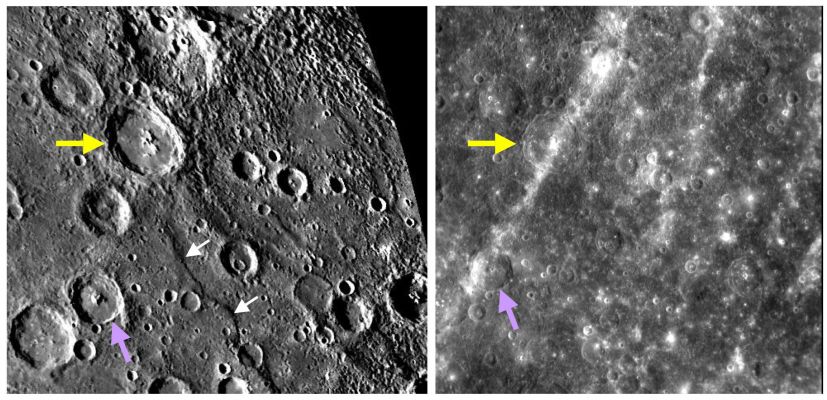
Of Interest: This pair of images illustrates the dramatic effect that illumination and viewing geometry (i.e., the angle at which Sunlight strikes the surface, and the angle from which the spacecraft views the surface) has on the appearance of terrain on Mercury. The image on the right is a frame captured by MESSENGER’s NAC as the spacecraft was departing the planet after its second Mercury flyby. On the left is a portion of a mosaic made from Mariner 10 clear-filter images, obtained by that mission in 1974. The yellow arrows point to the 90-Km- (56-mile-) diameter crater Asvaghosa (named for the first century AD Indian philosopher and poet), and the purple arrows indicate a smaller crater to the southwest. A bright ray, prominently visible in the high-Sun MESSENGER frame, crosses both craters. The stripe of high-reflectance material may have originated at Kuiper crater (to the southwest) or may come from a newly imaged crater to the northeast that has an extensive ray system. This ray and others seen in the NAC image were mostly invisible to Mariner 10, because low-Sun illumination emphasizes topography instead of differences in reflectance. As another example, the curving scarp (cliff) named Santa Maria Rupes (white arrows in the left image) is visible in the Mariner 10 image by the shadow it casts, but this rupes disappears in the MESSENGER image when the Sun is high overhead. Images collected under both high- and low-Sun conditions are needed for geologists to develop a complete understanding of the features on a planetary surface.
Parole chiave: Mercury

Changings...

Date Acquired: October 6, 2008
Image Mission Elapsed Time (MET): 131774145
Instrument: Narrow Angle Camera (NAC) of the Mercury Dual Imaging System (MDIS)
Resolution: 550 meters/pixel (0,34 miles/pixel)
Scale: Asvaghosa crater is approx. 90 Km in diameter (about 56 miles)
Spacecraft Altitude: about 21.000 Km (approx. 13.000 miles)

Of Interest: This pair of images illustrates the dramatic effect that illumination and viewing geometry (i.e., the angle at which Sunlight strikes the surface, and the angle from which the spacecraft views the surface) has on the appearance of terrain on Mercury. The image on the right is a frame captured by MESSENGER’s NAC as the spacecraft was departing the planet after its second Mercury flyby. On the left is a portion of a mosaic made from Mariner 10 clear-filter images, obtained by that mission in 1974. The yellow arrows point to the 90-Km- (56-mile-) diameter crater Asvaghosa (named for the first century AD Indian philosopher and poet), and the purple arrows indicate a smaller crater to the southwest. A bright ray, prominently visible in the high-Sun MESSENGER frame, crosses both craters. The stripe of high-reflectance material may have originated at Kuiper crater (to the southwest) or may come from a newly imaged crater to the northeast that has an extensive ray system. This ray and others seen in the NAC image were mostly invisible to Mariner 10, because low-Sun illumination emphasizes topography instead of differences in reflectance. As another example, the curving scarp (cliff) named Santa Maria Rupes (white arrows in the left image) is visible in the Mariner 10 image by the shadow it casts, but this rupes disappears in the MESSENGER image when the Sun is high overhead. Images collected under both high- and low-Sun conditions are needed for geologists to develop a complete understanding of the features on a planetary surface.

ZZ-Mercury-Craters-Crater_Field-PIA13823-1.jpg ZZ-Mercury-Craters-Crater_Field-PIA13823-2-PCF-LXTT_(2).jpg ZZ-Mercury-Craters-Crater_Field.jpg ZZ-Mercury-Craters-Cratered_Plains-PIA12050.jpg ZZ-Mercury-Craters-Damer_Crater-PIA17812-PCF-LXTT-IPF.jpg
Informazioni sul file
Nome del file:ZZ-Mercury-Craters-Crater_Field.jpg
Nome album:MareKromium / Mercury
Valutazione (3 voti):55555(Mostra dettagli)
Parole chiave:Mercury
Copyright:NASA/Johns Hopkins University Applied Physics Laboratory/Carnegie Institution of Washington e Lunar Explorer Italia per l'additional processing e la colorizzazione
Dimensione del file:624 KiB
Data di inserimento:Ott 17, 2008
Dimensioni:2560 x 1237 pixels
Visualizzato:54 volte
URL:https://www.lunexit.it/gallery/displayimage.php?pid=22217
Preferiti:Aggiungi ai preferiti


Powered by Coppermine Photo Gallery