Inizio Registrati Login

Elenco album Ultimi arrivi Ultimi commenti Più viste Più votate Preferiti Cerca

Inizio > SOLAR SYSTEM > Mercury
Ritorna alla pagina delle miniature FILE 85/248 Torna all'inizio Guarda foto precedente Guarda foto successiva Salta alla fine
Fresh Primary Impact Crater and Secondary Craters (HR)
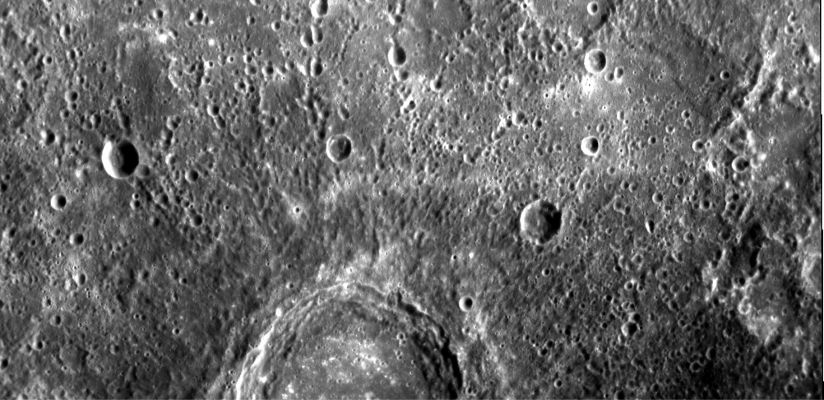
On January 14, 2008, NASA’s MESSENGER spacecraft observed about half of the hemisphere not seen by Mariner 10. This image shows part of a large, fresh crater with secondary crater chains located near Mercury’s Equator on the side of the Planet newly imaged by MESSENGER. 
Large, flat-floored craters show terraced rims from post-impact collapse of their newly formed walls. The hundreds of secondary impactors that are excavated from the Planet’s surface by an incoming object, create long, linear crater chains radial to the main crater. 
These chains, in addition to the rest of the ejecta blanket, create the complicated, hilly terrain surrounding the primary crater in the image. By counting craters that have formed since the impact event, the age of the crater can be estimated. 
This count can then be compared with a similar count for the crater floor to determine whether any material has partially filled the crater since its formation. With their large size and production of abundant secondary craters, these flat-floored craters both illuminate and confound the study of the geological history of Mercury. 
Parole chiave: Mercury Fly-By

Fresh Primary Impact Crater and Secondary Craters (HR)

On January 14, 2008, NASA’s MESSENGER spacecraft observed about half of the hemisphere not seen by Mariner 10. This image shows part of a large, fresh crater with secondary crater chains located near Mercury’s Equator on the side of the Planet newly imaged by MESSENGER.
Large, flat-floored craters show terraced rims from post-impact collapse of their newly formed walls. The hundreds of secondary impactors that are excavated from the Planet’s surface by an incoming object, create long, linear crater chains radial to the main crater.
These chains, in addition to the rest of the ejecta blanket, create the complicated, hilly terrain surrounding the primary crater in the image. By counting craters that have formed since the impact event, the age of the crater can be estimated.
This count can then be compared with a similar count for the crater floor to determine whether any material has partially filled the crater since its formation. With their large size and production of abundant secondary craters, these flat-floored craters both illuminate and confound the study of the geological history of Mercury.

ZZ-Mercury-Craters-Copland_Crater-PIA13068.jpg ZZ-Mercury-Craters-Crater_Cluster-208907.jpg ZZ-Mercury-Craters-Crater_Field-208852.jpg ZZ-Mercury-Craters-Crater_Field-PIA13823-1.jpg ZZ-Mercury-Craters-Crater_Field-PIA13823-2-PCF-LXTT_(2).jpg
Informazioni sul file
Nome del file:ZZ-Mercury-Craters-Crater_Field-208852.jpg
Nome album:MareKromium / Mercury
Valutazione (4 voti):55555(Mostra dettagli)
Parole chiave:Mercury / Fly-By
Copyright:NASA/Johns Hopkins University Applied Physics Laboratory/Carnegie Institution of Washington
Dimensione del file:717 KiB
Data di inserimento:Gen 19, 2008
Dimensioni:1826 x 886 pixels
Visualizzato:54 volte
URL:https://www.lunexit.it/gallery/displayimage.php?pid=19322
Preferiti:Aggiungi ai preferiti


Powered by Coppermine Photo Gallery