Inizio Registrati Login

Elenco album Ultimi arrivi Ultimi commenti Più viste Più votate Preferiti Cerca

Inizio > SOLAR SYSTEM > Jupiter: the "King" and His Moons
Ritorna alla pagina delle miniature FILE 264/325 Torna all'inizio Guarda foto precedente Guarda foto successiva Salta alla fine
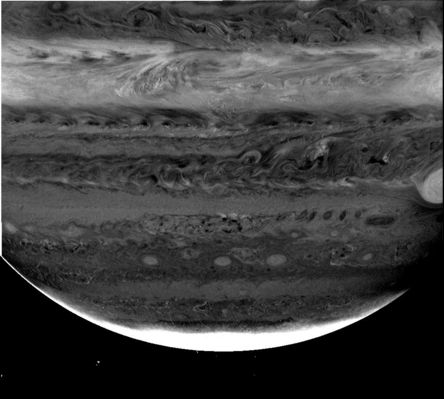
A "deep look" in the "deep clouds" of Jupiter
Finally, this is the combination of the 3 images taken from Cassini using the 3 different filters. 
This picture reveals cloud structures and movements at different depths in the atmosphere around Jupiter's South Pole. Cassini's cameras come equipped with filters that sample 3 wavelengths where Methane gas absorbs light. These are in the RED (619 nnmts) and in the NEAR-INFRARED (at 727 and 890 nnmts). Absorption in the 619 nnmts filter is weak. It is stronger in the 727 nnmts band and very strong in the 890 nnmts band where 90% of the light is absorbed by Methane gas. 
Light in the weakest band can penetrate the deepest into Jupiter's atmosphere. It is sensitive to the amount of cloud and haze down to the pressure of the water cloud (which lies at a depth where pressure is about 6 times the atmospheric pressure at sea level on the Earth). 
Light in the strongest methane band is absorbed at high altitude and is sensitive only to Ammonia cloud level and higher (with pressures less than about one-half of Earth's atmospheric pressure) and the middle methane band is sensitive to the ammonia and ammonium hydrosulfide cloud layers as deep as two times Earth's atmospheric pressure.
Parole chiave: Jupiter

A "deep look" in the "deep clouds" of Jupiter

Finally, this is the combination of the 3 images taken from Cassini using the 3 different filters.
This picture reveals cloud structures and movements at different depths in the atmosphere around Jupiter's South Pole. Cassini's cameras come equipped with filters that sample 3 wavelengths where Methane gas absorbs light. These are in the RED (619 nnmts) and in the NEAR-INFRARED (at 727 and 890 nnmts). Absorption in the 619 nnmts filter is weak. It is stronger in the 727 nnmts band and very strong in the 890 nnmts band where 90% of the light is absorbed by Methane gas.
Light in the weakest band can penetrate the deepest into Jupiter's atmosphere. It is sensitive to the amount of cloud and haze down to the pressure of the water cloud (which lies at a depth where pressure is about 6 times the atmospheric pressure at sea level on the Earth).
Light in the strongest methane band is absorbed at high altitude and is sensitive only to Ammonia cloud level and higher (with pressures less than about one-half of Earth's atmospheric pressure) and the middle methane band is sensitive to the ammonia and ammonium hydrosulfide cloud layers as deep as two times Earth's atmospheric pressure.

Jupiter-PIA02865-2.JPG Jupiter-PIA02865-3.JPG Jupiter-PIA02865-4.jpg Jupiter-PIA02873.jpg Jupiter-PIA02880.jpg
Informazioni sul file
Nome del file:Jupiter-PIA02865-4.jpg
Nome album:Jupiter: the "King" and His Moons
Valutazione (7 voti):55555(Mostra dettagli)
Parole chiave:Jupiter
Copyright:NASA - Cassini Mission
Dimensione del file:132 KiB
Data di inserimento:Gen 03, 2006
Dimensioni:1027 x 924 pixels
Visualizzato:56 volte
URL:https://www.lunexit.it/gallery/displayimage.php?pid=9036
Preferiti:Aggiungi ai preferiti


Powered by Coppermine Photo Gallery