Inizio Registrati Login

Elenco album Ultimi arrivi Ultimi commenti Più viste Più votate Preferiti Cerca

Inizio > SOLAR SYSTEM > Jupiter: the "King" and His Moons
Ritorna alla pagina delle miniature FILE 161/325 Torna all'inizio Guarda foto precedente Guarda foto successiva Salta alla fine
Pillan Patera
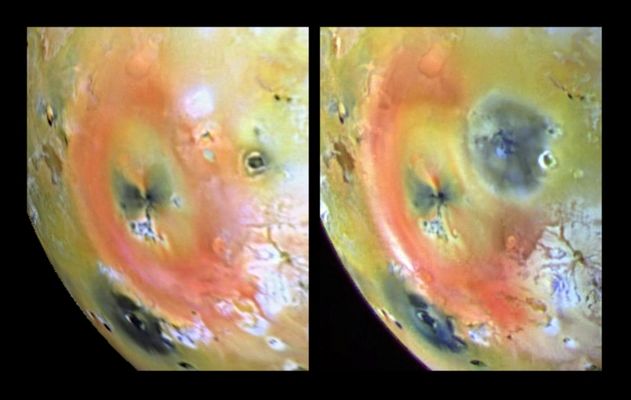
These images of Jupiter's volcanic moon, Io, show the results of a dramatic event that occurred on the fiery satellite during a five-month period. The changes, captured by the solid state imaging (CCD) system on NASA's Galileo spacecraft, occurred between the time Galileo acquired the left frame, during its seventh orbit of Jupiter, and the right frame, during its tenth orbit. A new dark spot, 400 kilometers (249 miles) in diameter, which is roughly the size of Arizona, surrounds a volcanic center named Pillan Patera. Galileo imaged a 120 kilometer (75 mile) high plume erupting from this location during its ninth orbit. Pele, which produced the larger plume deposit southwest of Pillan, also appears different than it did during the seventh orbit, perhaps due to interaction between the two large plumes. Pillan's plume deposits appear dark at all wavelengths. This color differs from the very red color associated with Pele, but is similar to the deposits of Babbar Patera, the dark feature southwest of Pele. Some apparent differences between the images are not caused by changes on Io's surface, but rather are due to differences in illumination, emission and phase angles. This is particularly apparent at Babbar Patera.
North is to the top of the images. The left frame was acquired on April 4th, 1997, while the right frame was taken on Sept. 19th, 1997. The images were obtained at ranges of 563,000 kilometers (350,000 miles) for the left image, and 505,600 kilometers (314,165 miles) for the right.

Parole chiave: Jupiter Moons - Io

Pillan Patera

These images of Jupiter's volcanic moon, Io, show the results of a dramatic event that occurred on the fiery satellite during a five-month period. The changes, captured by the solid state imaging (CCD) system on NASA's Galileo spacecraft, occurred between the time Galileo acquired the left frame, during its seventh orbit of Jupiter, and the right frame, during its tenth orbit. A new dark spot, 400 kilometers (249 miles) in diameter, which is roughly the size of Arizona, surrounds a volcanic center named Pillan Patera. Galileo imaged a 120 kilometer (75 mile) high plume erupting from this location during its ninth orbit. Pele, which produced the larger plume deposit southwest of Pillan, also appears different than it did during the seventh orbit, perhaps due to interaction between the two large plumes. Pillan's plume deposits appear dark at all wavelengths. This color differs from the very red color associated with Pele, but is similar to the deposits of Babbar Patera, the dark feature southwest of Pele. Some apparent differences between the images are not caused by changes on Io's surface, but rather are due to differences in illumination, emission and phase angles. This is particularly apparent at Babbar Patera.
North is to the top of the images. The left frame was acquired on April 4th, 1997, while the right frame was taken on Sept. 19th, 1997. The images were obtained at ranges of 563,000 kilometers (350,000 miles) for the left image, and 505,600 kilometers (314,165 miles) for the right.

Io-Pele plume-PIA02546_modest.jpg Io-Pele-PIA01112.jpg Io-PillanPatera-PIA00744.jpg Io-Plumes from Loki-V1-PIA00010_modest.jpg Io-Plumes-PIA01081.jpg
Informazioni sul file
Nome del file:Io-PillanPatera-PIA00744.jpg
Nome album:Jupiter: the "King" and His Moons
Valutazione (6 voti):55555(Mostra dettagli)
Parole chiave:Jupiter / Moons / - / Io
Copyright:NASA - Galileo Project
Dimensione del file:63 KiB
Data di inserimento:Ott 20, 2005
Dimensioni:1124 x 712 pixels
Visualizzato:58 volte
URL:https://www.lunexit.it/gallery/displayimage.php?pid=7897
Preferiti:Aggiungi ai preferiti


Powered by Coppermine Photo Gallery