Inizio Registrati Login

Elenco album Ultimi arrivi Ultimi commenti Più viste Più votate Preferiti Cerca

Inizio > SOLAR SYSTEM > Jupiter: the "King" and His Moons
Ritorna alla pagina delle miniature FILE 230/325 Torna all'inizio Guarda foto precedente Guarda foto successiva Salta alla fine
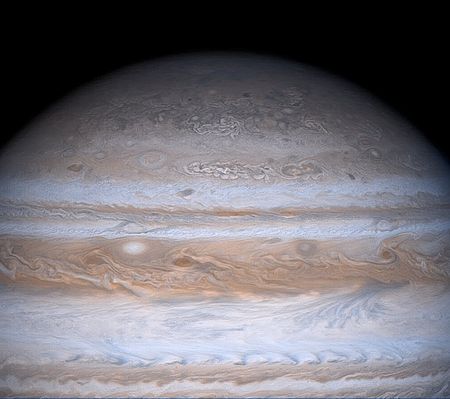
Jupiter's North Pole (HR)
Da "NASA - Picture of the Day" dell'11-09-2005:"Gas giant Jupiter is the Solar System's largest world with about 320 times the mass of Earth. Famous for its Great Red Spot, Jupiter is also known for its regular, equatorial cloud bands, also visible in very modest sized telescopes. 
The dark belts and light-colored zones of Jupiter's cloud bands are organized by the Planet's girdling winds which reach speeds of up to 500 Km/hour. On toward the Jovian poles though, the cloud structures become more mottled and convoluted until, as in this Cassini spacecraft mosaic of Jupiter, the Planet's Polar Region begins to look something like a brain. This striking equator-to-pole change in cloud patterns is not presently understood, but may be due in part to the effect of Jupiter's rapid rotation or to convection vortices generated at high latitudes by the massive Planet's internal heat loss. 
Cassini took this dramatically detailed view of Jupiter in December 2000, during its flyby enroute to Saturn".
Parole chiave: Jupiter

Jupiter's North Pole (HR)

Da "NASA - Picture of the Day" dell'11-09-2005:"Gas giant Jupiter is the Solar System's largest world with about 320 times the mass of Earth. Famous for its Great Red Spot, Jupiter is also known for its regular, equatorial cloud bands, also visible in very modest sized telescopes.
The dark belts and light-colored zones of Jupiter's cloud bands are organized by the Planet's girdling winds which reach speeds of up to 500 Km/hour. On toward the Jovian poles though, the cloud structures become more mottled and convoluted until, as in this Cassini spacecraft mosaic of Jupiter, the Planet's Polar Region begins to look something like a brain. This striking equator-to-pole change in cloud patterns is not presently understood, but may be due in part to the effect of Jupiter's rapid rotation or to convection vortices generated at high latitudes by the massive Planet's internal heat loss.
Cassini took this dramatically detailed view of Jupiter in December 2000, during its flyby enroute to Saturn".

Jupiter-CH-PIA02877_modest.jpg Jupiter-Clouds_NewHorizons_big.jpg Jupiter-HR.jpg Jupiter-HST-2008-42-a-ful-001_jpg.jpg Jupiter-HST-2008-42-a-ful-002_jpg.jpg
Informazioni sul file
Nome del file:Jupiter-HR.jpg
Nome album:Jupiter: the "King" and His Moons
Valutazione (13 voti):55555(Mostra dettagli)
Parole chiave:Jupiter
Copyright:NASA - Cassini-Huygens Mission
Dimensione del file:161 KiB
Data di inserimento:Set 11, 2005
Dimensioni:1001 x 888 pixels
Visualizzato:58 volte
URL:https://www.lunexit.it/gallery/displayimage.php?pid=7247
Preferiti:Aggiungi ai preferiti


Powered by Coppermine Photo Gallery