Inizio Registrati Login

Elenco album Ultimi arrivi Ultimi commenti Più viste Più votate Preferiti Cerca

Inizio > SOLAR SYSTEM > Jupiter: the "King" and His Moons
Ritorna alla pagina delle miniature FILE 18/325 Torna all'inizio Guarda foto precedente Guarda foto successiva Salta alla fine
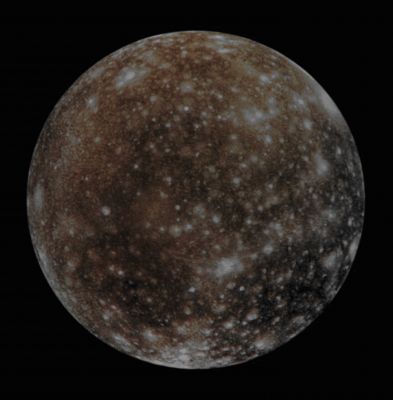
Approaching Callisto (Absolute Natural Colors; credits for the additional process. and color.: Dr Paolo C. Fienga/Lunar Explorer Italia/Italian Planetary Foundation)
Bright scars on a darker Surface testify to a long history of impacts on the Jovian moon Callisto, as it can be seen in this image obtained by the NASA - Galileo Spacecraft. The picture, taken in May 2001, is the only complete global Absolute Natural Color image of Callisto ever obtained by the NASA - Galileo Spacecraft, which orbited around Jupiter from December, 7, of the AD 1995 and until September 21, of the AD 2003, when the Spacecraft was destroyed during a controlled impact with Jupiter itself. 
Of Jupiter's 4 (four) largest moons (also known as the "Galilean Moons"), Callisto orbits farthest from the Giant Gas Planet. Furthermore, Callisto's Surface is uniformly cratered but, as you can see for yourself, is not uniform in color or brightness at all. At present day, Planetary Scientists believe that the brighter areas are mainly Ice while the darker ones should be made of highly eroded (and Ice-poor) Rocky Materials. 

This frame (which is an Original NASA - Galileo Spacecraft color frame published on the NASA - Planetary Photojournal with the ID n. PIA 03456) has been additionally processed and then re-colorized, according to an educated guess, by Dr Paolo C. Fienga (LXTT-IPF), in Absolute Natural Colors (such as the colors that a human eye would actually perceive if someone were onboard the NASA - Galileo Spacecraft and then looked outside, towards the Jovian moon Callisto), by using an original technique created - and, in time, dramatically improved - by the Lunar Explorer Italia Team. Different colors, as well as different shades of the same color, mean, among others, the existence of different Elements present on the Surface of Callisto, each having a different Albedo (---> Reflectivity) and Chemical Composition.
Parole chiave: Jovian Moons - Callisto

Approaching Callisto (Absolute Natural Colors; credits for the additional process. and color.: Dr Paolo C. Fienga/Lunar Explorer Italia/Italian Planetary Foundation)

Bright scars on a darker Surface testify to a long history of impacts on the Jovian moon Callisto, as it can be seen in this image obtained by the NASA - Galileo Spacecraft. The picture, taken in May 2001, is the only complete global Absolute Natural Color image of Callisto ever obtained by the NASA - Galileo Spacecraft, which orbited around Jupiter from December, 7, of the AD 1995 and until September 21, of the AD 2003, when the Spacecraft was destroyed during a controlled impact with Jupiter itself.
Of Jupiter's 4 (four) largest moons (also known as the "Galilean Moons"), Callisto orbits farthest from the Giant Gas Planet. Furthermore, Callisto's Surface is uniformly cratered but, as you can see for yourself, is not uniform in color or brightness at all. At present day, Planetary Scientists believe that the brighter areas are mainly Ice while the darker ones should be made of highly eroded (and Ice-poor) Rocky Materials.

This frame (which is an Original NASA - Galileo Spacecraft color frame published on the NASA - Planetary Photojournal with the ID n. PIA 03456) has been additionally processed and then re-colorized, according to an educated guess, by Dr Paolo C. Fienga (LXTT-IPF), in Absolute Natural Colors (such as the colors that a human eye would actually perceive if someone were onboard the NASA - Galileo Spacecraft and then looked outside, towards the Jovian moon Callisto), by using an original technique created - and, in time, dramatically improved - by the Lunar Explorer Italia Team. Different colors, as well as different shades of the same color, mean, among others, the existence of different Elements present on the Surface of Callisto, each having a different Albedo (---> Reflectivity) and Chemical Composition.

Callisto-PIA00080-PCF-LXTT-IPF.jpg Callisto-PIA02277-PCF-LXTT-IPF.jpg Callisto-PIA03456-PCF-LXTT-IPF.jpg Callisto-V1-PIA00362_modest.jpg Callisto-V1-PIA02277_modest.jpg
Informazioni sul file
Nome del file:Callisto-PIA03456-PCF-LXTT-IPF.jpg
Nome album:MareKromium / Jupiter: the "King" and His Moons
Valutazione (2 voti):55555(Mostra dettagli)
Parole chiave:Jovian / Moons / - / Callisto
Copyright:NASA/JPL - Galileo Mission and Dr Paolo C. Fienga/Lunar Explorer Italia/IPF for the additional process. and color.
Dimensione del file:446 KiB
Data di inserimento:Feb 14, 2013
Dimensioni:2900 x 2951 pixels
Visualizzato:73 volte
URL:https://www.lunexit.it/gallery/displayimage.php?pid=31020
Preferiti:Aggiungi ai preferiti


Powered by Coppermine Photo Gallery