Inizio Registrati Login

Elenco album Ultimi arrivi Ultimi commenti Più viste Più votate Preferiti Cerca

Inizio > SOLAR SYSTEM > Jupiter: the "King" and His Moons
Ritorna alla pagina delle miniature FILE 136/325 Torna all'inizio Guarda foto precedente Guarda foto successiva Salta alla fine
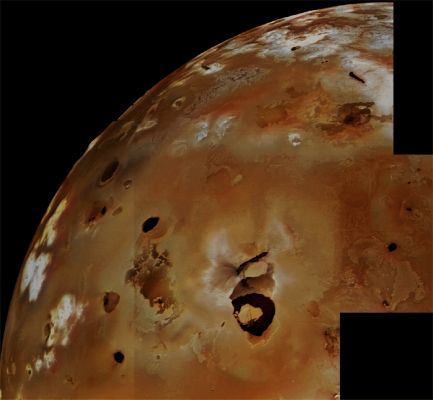
Volcanic Plains and Paterae on Io: Loki Patera (Absolute Natural Colors; credits for the additional process. and color.: Dr Paolo C. Fienga/Lunar Explorer Italia/Italian Planetary Foundation)
A huge area of Io's Volcanic Plains is well shown in this mosaic of pictures taken by the NASA - Voyager 1 Space Probe. Numerous Volcanic Calderas and Lava Flows are visible here, including the Loki Patera (an active Lava Lake), which is the large shield-shaped and dark red Surface Feature visible in the lower right portion of the mosaic. As a matter of fact, the (sometime) intense light emitted from the Lava that boils inside Loki Patera can even be seen through telescopes, all the way from Earth, and these observations tell us that Loki has been active continuously (or at least every time an astronomer took a good look at it...) since the Voyager 1 Fly-By, which occurred in the month of March of the AD 1979. 
The composition of Io's Volcanic Plains and Lava Flows has not been completely determined yet but, in the light of the information that we already possess (and, in particular, once we duly consider the orange-yellow color that can be seen over most of the Surface of Io), it is reasonable to say that they could dominantly consist of Sulphur, with Surface Frosts made of Sulphur Dioxide, Silicates (such as Basalts) encrusted with Sulphur and Sulphur Dioxide Condensates. The bright whitish patches, on the other hand, could probably consist of freshly deposited Sulphur Dioxide Frost. The dark red (and, sometime, almost black) spots, including Loki, are hot Sulphur Lava Lakes, which may remain molten even for a long time, thanks to the intrusions of molten Silicate Magma that (probably in an almost continuous way) comes up from deep inside Io. However, the very ultimate source of heat that keeps Io active, must be the Tidal (Frictional) Heating, due to the perpetual flexure of Io that is caused by the powerful Gravitational Influence of both Jupiter and Europa.
This picture (which is an Original NASA - Voyager 1 Space Proble color image mosaic published on the NASA - Planetary Photojournal with the n. PIA 00320) has been additionally processed and then re-colorized in Absolute Natural Colors (such as the colors that a human eye would actually perceive if someone were onboard the NASA - Voyager 1 Space Probe and then looked outside, towards the limb of the Jovian moon Io), by using an original technique created - and, in time, dramatically improved - by the Lunar Explorer Italia Team. Different colors, as well as different shades of the same color, mean, among others, the existence of different Elements present on the Surface of Io, each having a different Albedo (---> Reflectivity) and Chemical Composition.
Parole chiave: Jovian Moons - Io

Volcanic Plains and Paterae on Io: Loki Patera (Absolute Natural Colors; credits for the additional process. and color.: Dr Paolo C. Fienga/Lunar Explorer Italia/Italian Planetary Foundation)

A huge area of Io's Volcanic Plains is well shown in this mosaic of pictures taken by the NASA - Voyager 1 Space Probe. Numerous Volcanic Calderas and Lava Flows are visible here, including the Loki Patera (an active Lava Lake), which is the large shield-shaped and dark red Surface Feature visible in the lower right portion of the mosaic. As a matter of fact, the (sometime) intense light emitted from the Lava that boils inside Loki Patera can even be seen through telescopes, all the way from Earth, and these observations tell us that Loki has been active continuously (or at least every time an astronomer took a good look at it...) since the Voyager 1 Fly-By, which occurred in the month of March of the AD 1979.
The composition of Io's Volcanic Plains and Lava Flows has not been completely determined yet but, in the light of the information that we already possess (and, in particular, once we duly consider the orange-yellow color that can be seen over most of the Surface of Io), it is reasonable to say that they could dominantly consist of Sulphur, with Surface Frosts made of Sulphur Dioxide, Silicates (such as Basalts) encrusted with Sulphur and Sulphur Dioxide Condensates. The bright whitish patches, on the other hand, could probably consist of freshly deposited Sulphur Dioxide Frost. The dark red (and, sometime, almost black) spots, including Loki, are hot Sulphur Lava Lakes, which may remain molten even for a long time, thanks to the intrusions of molten Silicate Magma that (probably in an almost continuous way) comes up from deep inside Io. However, the very ultimate source of heat that keeps Io active, must be the Tidal (Frictional) Heating, due to the perpetual flexure of Io that is caused by the powerful Gravitational Influence of both Jupiter and Europa.
This picture (which is an Original NASA - Voyager 1 Space Proble color image mosaic published on the NASA - Planetary Photojournal with the n. PIA 00320) has been additionally processed and then re-colorized in Absolute Natural Colors (such as the colors that a human eye would actually perceive if someone were onboard the NASA - Voyager 1 Space Probe and then looked outside, towards the limb of the Jovian moon Io), by using an original technique created - and, in time, dramatically improved - by the Lunar Explorer Italia Team. Different colors, as well as different shades of the same color, mean, among others, the existence of different Elements present on the Surface of Io, each having a different Albedo (---> Reflectivity) and Chemical Composition.

Io-Ionian Mountains and calderas-PIA02526.jpg Io-LokiPatera-PIA00320.jpg Io-Loki_Patera-PIA00320-PCF-LXTT-IPF.jpg Io-Masubi plume-GAL-PIA02502_modest.jpg Io-Natural_Colors-NASA.jpg
Informazioni sul file
Nome del file:Io-Loki_Patera-PIA00320-PCF-LXTT-IPF.jpg
Nome album:MareKromium / Jupiter: the "King" and His Moons
Valutazione (4 voti):55555(Mostra dettagli)
Parole chiave:Jovian / Moons / - / Io
Copyright:NASA - Voyager 1 Project; credits for the additional process.: Paolo C. Fienga
Dimensione del file:656 KiB
Data di inserimento:Set 30, 2012
Dimensioni:3000 x 2770 pixels
Visualizzato:97 volte
URL:https://www.lunexit.it/gallery/displayimage.php?pid=30818
Preferiti:Aggiungi ai preferiti

Commento 1 a 5 di 5
Pagina: 1

MareKromium   [Ott 06, 2020 at 08:29 PM]
Ragazzi, ma abbandoniamo Marte per un pò ed andiamo "oltre". Per esempio, su Io, od Europa, od Encelado, o Caronte ecc. Tanto, di Marte parlano (a vanvera) più o meno tutti. Ed allora, andiamo più lontano. In ogni caso, come ho già scritto, in questa Vita, le risposte non le avremo. E allora...sognamo un pò!!! ;-)
walthari   [Ott 06, 2020 at 08:43 PM]
non sottovalutiamo infatti la possibilità di vita sulle Lune di Giove o di Saturno o chissà nella fase acquosa di Cerere o nei mari di idrocarburi plutoniani....
MareKromium   [Ott 07, 2020 at 08:29 PM]
...E cosa "vive" nei laghi, fiumi e mari di Titano, secondo te?... ;-)
walthari   [Ott 07, 2020 at 08:45 PM]
Titano senz'altro....e chissà quali organismi; eppoi dai che figata è il ciclo del metano?
MareKromium   [Nov 16, 2020 at 12:24 PM]
Qualcosa che non saprei spiegare... ;-)

Commento 1 a 5 di 5
Pagina: 1


Powered by Coppermine Photo Gallery