Inizio Registrati Login

Elenco album Ultimi arrivi Ultimi commenti Più viste Più votate Preferiti Cerca

Inizio > SOLAR SYSTEM > Jupiter: the "King" and His Moons
Ritorna alla pagina delle miniature FILE 235/325 Torna all'inizio Guarda foto precedente Guarda foto successiva Salta alla fine
Something's happening inside Jupiter...
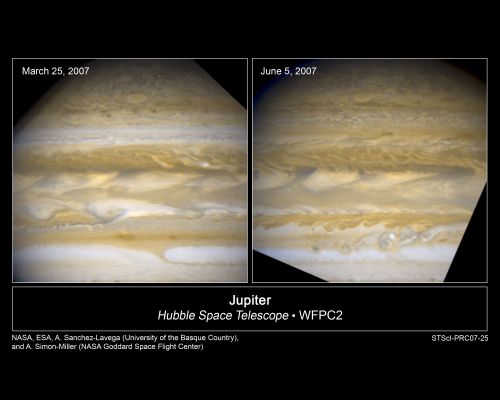
Massive Jupiter is undergoing dramatic atmospheric changes that have never been seen before with the keen "eye" of NASA's Hubble Space Telescope. 

Jupiter's turbulent clouds are always changing as they encounter atmospheric disturbances while sweeping around the planet at hundreds of miles per hour. But these Hubble images reveal a rapid transformation in the shape and color of Jupiter's clouds near the equator, marking an entire face of the globe.

The planet is wrapped in bands of yellows, browns, and whites. These bands are produced by the atmosphere flowing in different directions at various latitudes. Lighter-hued areas where the atmosphere rises are called zones. Darker regions where the atmosphere falls are called belts. When these opposing flows interact, storms and turbulence appear.

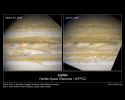
Between March 25 and June 5, Hubble's Wide Field and Planetary Camera 2 captured entire bands of clouds changing color. Zones have darkened into belts and belts have lightened and transformed into zones. Cloud features have rapidly altered in shape and size.

The image at left shows a thin band of white clouds above Jupiter's equator. The white color indicates clouds at higher altitudes in Jupiter's atmosphere. In the image at right, the band's white hue has turned brown, showing clouds deep within the planet's atmosphere. The whole band appears to have merged with the one below it. 

In the same cloud band above the equator, the small swirls in the left-hand image have morphed into larger wave-like features in the right-hand photo. Dominating the band is a dark streak that resembles a snake. This serpent-shaped structure is actually a small tear in the cloud deck, which gives astronomers a view deep within the atmosphere. 

Below the equatorial region, the brownish upside-down shark fin in the left-hand image disappears in the photo at right. Appearing instead are brownish tongue-shaped clouds with a stream of white swirls below them.

These global upheavals have been seen before, but not with Hubble's sharp resolution. Astronomers using ground-based telescopes first spied drastic atmospheric transformation in the 1980s. Another major disturbance was seen in the early 1990s, after Hubble was launched into space. The telescope, however, did not have the resolution to view the upheaval in fine detail. These higher-quality Hubble images may help astronomers understand how such global upheavals develop on Jupiter.


Parole chiave: From Space Images - Hubble Space Telescope - Jupiter

Something's happening inside Jupiter...

Massive Jupiter is undergoing dramatic atmospheric changes that have never been seen before with the keen "eye" of NASA's Hubble Space Telescope.

Jupiter's turbulent clouds are always changing as they encounter atmospheric disturbances while sweeping around the planet at hundreds of miles per hour. But these Hubble images reveal a rapid transformation in the shape and color of Jupiter's clouds near the equator, marking an entire face of the globe.

The planet is wrapped in bands of yellows, browns, and whites. These bands are produced by the atmosphere flowing in different directions at various latitudes. Lighter-hued areas where the atmosphere rises are called zones. Darker regions where the atmosphere falls are called belts. When these opposing flows interact, storms and turbulence appear.

Between March 25 and June 5, Hubble's Wide Field and Planetary Camera 2 captured entire bands of clouds changing color. Zones have darkened into belts and belts have lightened and transformed into zones. Cloud features have rapidly altered in shape and size.

The image at left shows a thin band of white clouds above Jupiter's equator. The white color indicates clouds at higher altitudes in Jupiter's atmosphere. In the image at right, the band's white hue has turned brown, showing clouds deep within the planet's atmosphere. The whole band appears to have merged with the one below it.

In the same cloud band above the equator, the small swirls in the left-hand image have morphed into larger wave-like features in the right-hand photo. Dominating the band is a dark streak that resembles a snake. This serpent-shaped structure is actually a small tear in the cloud deck, which gives astronomers a view deep within the atmosphere.

Below the equatorial region, the brownish upside-down shark fin in the left-hand image disappears in the photo at right. Appearing instead are brownish tongue-shaped clouds with a stream of white swirls below them.

These global upheavals have been seen before, but not with Hubble's sharp resolution. Astronomers using ground-based telescopes first spied drastic atmospheric transformation in the 1980s. Another major disturbance was seen in the early 1990s, after Hubble was launched into space. The telescope, however, did not have the resolution to view the upheaval in fine detail. These higher-quality Hubble images may help astronomers understand how such global upheavals develop on Jupiter.

Jupiter-HST-2008-42-a-ful-003_jpg.jpg Jupiter-HST-2008-42-a-ful-004_jpg.jpg Jupiter-HST.jpg Jupiter-HST~0.jpg Jupiter-HW-PIA00360_modest.jpg
Informazioni sul file
Nome del file:Jupiter-HST.jpg
Nome album:MareKromium / Jupiter: the "King" and His Moons
Valutazione (6 voti):55555(Mostra dettagli)
Parole chiave:From / Space / Images / - / Hubble / Space / Telescope / - / Jupiter
Copyright:NASA, ESA, A. Simon-Miller (NASA Goddard Space Flight Center)
Dimensione del file:526 KiB
Data di inserimento:Giu 29, 2007
Dimensioni:3000 x 2400 pixels
Visualizzato:57 volte
URL:https://www.lunexit.it/gallery/displayimage.php?pid=17301
Preferiti:Aggiungi ai preferiti


Powered by Coppermine Photo Gallery