Inizio Registrati Login

Elenco album Ultimi arrivi Ultimi commenti Più viste Più votate Preferiti Cerca

Inizio > SOLAR SYSTEM > Venus
Ritorna alla pagina delle miniature FILE 24/126 Torna all'inizio Guarda foto precedente Guarda foto successiva Salta alla fine
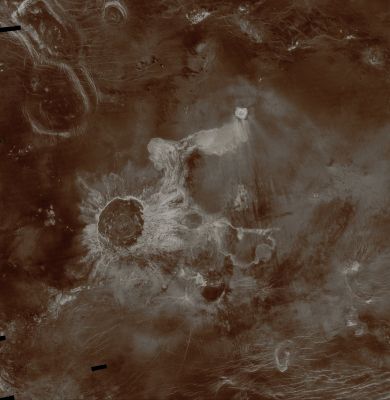
Isabella Crater (possible Natural Colors; credits: Dr Paolo C. Fienga - Lunexit Team)
Crater Isabella, with a diameter of approx. 175 Km (such as about 108 miles), seen in this MRI (Magellan Radar Image), is the second largest Impact Crater on Venus. 

The feature is named in honor of the 15th Century Queen of Spain, Isabella of Castile. Located at 30° South Latitude and 204° East Longitude, the Crater has two extensive flow-like structures extending to the South and to the S/E. 
The end of the Southern Flow partially surrounds a pre-existing 40 Km (approx. 25 mile) circular Volcanic Shield. 
The South-Eastern Flow shows a complex pattern of Channels and Flow Lobes, and is overlain at its South-Eastern tip by deposits from a later approx. 20 Km (about 12 mile) diameter Impact Crater, Cohn (for Carola Cohn, Australian artist, 1892-1964). 

The extensive Flows, unique to Venusian Impact Craters, are a continuing subject of study for a number of Planetary Scientists. It is thought that the Flows may consist of "Impact Melt", suc as rock melted by the intense heat released in the impact explosion. An alternate hypothesis invokes "Debris Flows", which may consist of clouds of hot gases and both melted and solid rock fragments that race across the landscape during the impact event. 

That type of Emplacement Process is similar to that which occurs in violent eruptions on Earth, such as the 1991 Mount Pinatubo eruption in the Philippines.
Parole chiave: Venus from orbit - Craters - Isabella Crater

Isabella Crater (possible Natural Colors; credits: Dr Paolo C. Fienga - Lunexit Team)

Crater Isabella, with a diameter of approx. 175 Km (such as about 108 miles), seen in this MRI (Magellan Radar Image), is the second largest Impact Crater on Venus.

The feature is named in honor of the 15th Century Queen of Spain, Isabella of Castile. Located at 30° South Latitude and 204° East Longitude, the Crater has two extensive flow-like structures extending to the South and to the S/E.
The end of the Southern Flow partially surrounds a pre-existing 40 Km (approx. 25 mile) circular Volcanic Shield.
The South-Eastern Flow shows a complex pattern of Channels and Flow Lobes, and is overlain at its South-Eastern tip by deposits from a later approx. 20 Km (about 12 mile) diameter Impact Crater, Cohn (for Carola Cohn, Australian artist, 1892-1964).

The extensive Flows, unique to Venusian Impact Craters, are a continuing subject of study for a number of Planetary Scientists. It is thought that the Flows may consist of "Impact Melt", suc as rock melted by the intense heat released in the impact explosion. An alternate hypothesis invokes "Debris Flows", which may consist of clouds of hot gases and both melted and solid rock fragments that race across the landscape during the impact event.

That type of Emplacement Process is similar to that which occurs in violent eruptions on Earth, such as the 1991 Mount Pinatubo eruption in the Philippines.

Craters-Geopert_Crater-PIA00269.jpg Craters-Ghost_Crater_in_Lakshmi_Region-PIA00477-PCF-LXTT-IPF.jpg Craters-Isabella_Crater-PIA00480.jpg Craters-Mona_Lisa_Crater-PCF-LXTT-00.jpg Craters-Mona_Lisa_Crater-PCF-LXTT-01.jpg
Informazioni sul file
Nome del file:Craters-Isabella_Crater-PIA00480.jpg
Nome album:MareKromium / Venus
Valutazione (3 voti):55555(Mostra dettagli)
Parole chiave:Venus / from / orbit / - / Craters / - / Isabella / Crater
Copyright:NASA/JPL - Magellan Probe Project e Paolo C. Fienga/Lunexit Team per l'additional process. e la colorizzazione
Dimensione del file:1131 KiB
Data di inserimento:Gen 30, 2010
Dimensioni:2526 x 2590 pixels
Visualizzato:56 volte
URL:https://www.lunexit.it/gallery/displayimage.php?pid=26206
Preferiti:Aggiungi ai preferiti


Powered by Coppermine Photo Gallery