Inizio Registrati Login

Elenco album Ultimi arrivi Ultimi commenti Più viste Più votate Preferiti Cerca

Inizio > SOLAR SYSTEM > Venus
Ritorna alla pagina delle miniature FILE 28/126 Torna all'inizio Guarda foto precedente Guarda foto successiva Salta alla fine
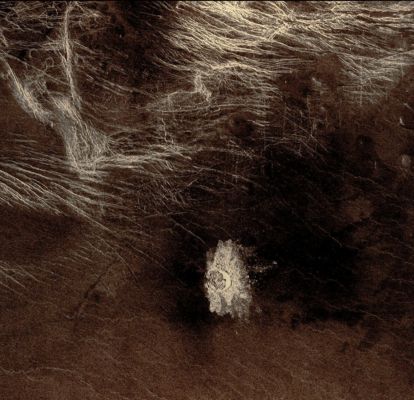
Stephania Crater (possible Natural Colors; credits: Dr Paolo C. Fienga - Lunexit Team)
Crater Stephania is located at 51,3° Norh Latitude and 333,3° East Longitude in Northern Sedna Planitia. 

With a diameter of about 11 Km (6,8 miles), Stephania is one of the smaller Craters on Venus. 
Because many small meteoroids disintegrate during their passage through the dense Venusian atmosphere, there is an absence of craters smaller than 3 Km (approx. 1,9 miles) in diameter, and even craters smaller than 25 Km (15,5 miles) are relatively scarce. 

The apron of ejected material suggests that the impacting body made contact with the Surface from an oblique angle. Upon closer observation it is possible to delineate secondary craters, impact scars from blocks ejected from the primary crater. 
A feature associated with this and many other Venusian Craters is a radar-dark halo. 
Since dark radar return signifies a smooth surface, it has been hypothesized that an intense shock wave removed or pulverized previously rough surface material or that a blanket of fine material was deposited during or after the impact.
Parole chiave: Venus from orbit - Craters - Stephania Crater

Stephania Crater (possible Natural Colors; credits: Dr Paolo C. Fienga - Lunexit Team)

Crater Stephania is located at 51,3° Norh Latitude and 333,3° East Longitude in Northern Sedna Planitia.

With a diameter of about 11 Km (6,8 miles), Stephania is one of the smaller Craters on Venus.
Because many small meteoroids disintegrate during their passage through the dense Venusian atmosphere, there is an absence of craters smaller than 3 Km (approx. 1,9 miles) in diameter, and even craters smaller than 25 Km (15,5 miles) are relatively scarce.

The apron of ejected material suggests that the impacting body made contact with the Surface from an oblique angle. Upon closer observation it is possible to delineate secondary craters, impact scars from blocks ejected from the primary crater.
A feature associated with this and many other Venusian Craters is a radar-dark halo.
Since dark radar return signifies a smooth surface, it has been hypothesized that an intense shock wave removed or pulverized previously rough surface material or that a blanket of fine material was deposited during or after the impact.

Craters-Mona_Lisa_Crater-PCF-LXTT-01.jpg Craters-Somerville_Crater-PIA00100.jpg Craters-Stephania_Crater-PIA00475.jpg Craters-Unnamed_Complex_Crater-PIA00462-PCF-LXTT-IPF.jpg Craters-Unnamed_Crater-PIA00468.jpg
Informazioni sul file
Nome del file:Craters-Stephania_Crater-PIA00475.jpg
Nome album:MareKromium / Venus
Valutazione (5 voti):55555(Mostra dettagli)
Parole chiave:Venus / from / orbit / - / Craters / - / Stephania / Crater
Copyright:NASA/JPL - Magellan Probe Project e Paolo C. Fienga/Lunexit Team per l'additional process. e la colorizzazione
Dimensione del file:416 KiB
Data di inserimento:Gen 30, 2010
Dimensioni:1553 x 1500 pixels
Visualizzato:56 volte
URL:https://www.lunexit.it/gallery/displayimage.php?pid=26202
Preferiti:Aggiungi ai preferiti


Powered by Coppermine Photo Gallery