|
|
The biggest "Geyser" in the Solar System: the Enceladus' Fountain
|
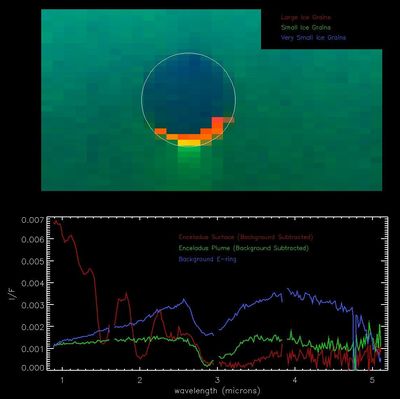
During a non-targeted flyby by the Cassini spacecraft of Enceladus on Nov. 26, 2005, the Cassini's Visual and Infrared Mapping Spectrometer (VIMS) measured the spectrum of the plumes originating from the South Pole of the icy moon. The instrument captured a very clear signature of small ice particles in the plume data, at the 2,9 micron wavelength. This image of Enceladus, taken with the VIMS, shows not only the plume over the South Pole, but also the dark side of the moon, silhouetted against a foggy background of light from the E-Ring.
The bottom graph shows the measurements of the spectrum, of this background light. It shows a very similar signature of small ice particles to that in the plumes, confirming earlier expectations that Enceladus is indeed the source of the E-Ring.
Preliminary analyses suggest that the average size of the particles in the plume is about 10 microns (or 1/100.000 of a meter). The particles in the E-Ring are about 3 times smaller.
The sunlit surface of Enceladus itself, visible as a thin crescent at the bottom of the image, is also composed of water ice, but with a much larger grain size than the plume.
|
|