|
|
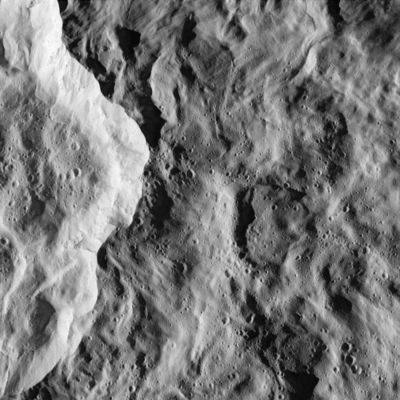
Rhea's "Ray Crater" (alias the "Great White Splat") and scarps from 511 Km
|
(...) Cassini spacecraft snapped this image of the Eastern rim of Saturn's moon Rhea's bright, Ray Crater. The impact event appears to have made a prominent bright splotch on the Leading Hemisphere of Rhea. Because Cassini was traveling so fast relative to Rhea as the flyby occurred, the crater would have been out of the camera's field of view in any earlier or later exposure. The crater's total diameter is about 50 Km, but this rim view shows details of terrains both interior to the crater and outside its rim. The prominent bright scarp, left of the center, is the crater wall, and the crater interior is to the left of the scarp. The exterior of the crater (right of the scarp) is characterized by softly undulating topography and gentle swirl-like patterns that formed during the emplacement of the large crater's continuous blanket of ejecta material.
Numerous small craters conspicuously pepper the larger crater's floor and much of the area immediately outside of it. However, in some places, such as terrain in the top portion of the image and the bright crater wall, the terrain appears remarkably free of the small impacts. The localized "shot pattern" and non-uniform distribution of these small craters indicate that they are most likely secondary impacts -- craters formed from fallback material excavated from a nearby primary impact site. Because they exist both inside and outside the large crater in this image, the source impact of the secondary impacts must have happened more recently than the impact event that formed the large crater in this scene.
|
|