Inizio Registrati Login

Elenco album Ultimi arrivi Ultimi commenti Più viste Più votate Preferiti Cerca

Inizio > SOLAR SYSTEM > Saturn: the "Ringed Beauty" and His Moons
Ritorna alla pagina delle miniature FILE 2060/2245 Torna all'inizio Guarda foto precedente Guarda foto successiva Salta alla fine
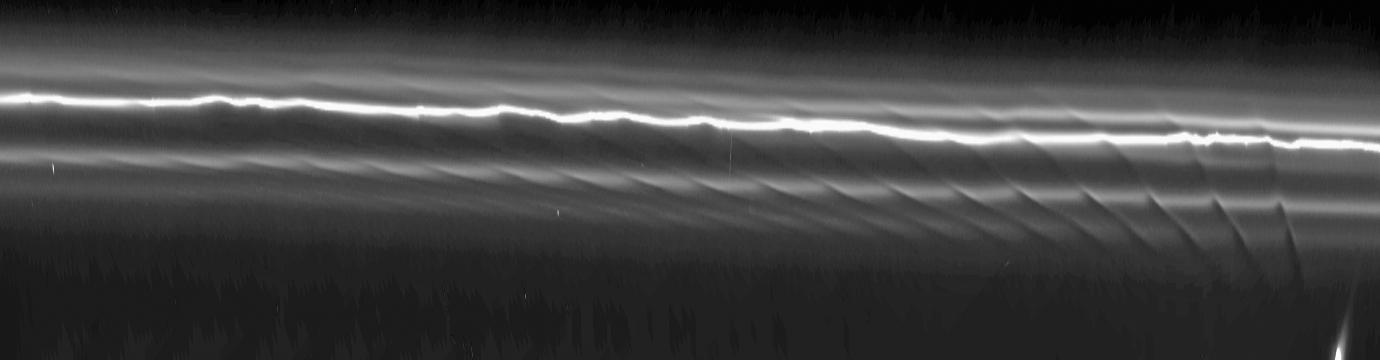
Surfing the waves of the F-Ring (from 1,1 MKM)
Original caption:"This mosaic of 15 Cassini images of Saturn's F-Ring shows how the moon Prometheus creates a gore in the Ring once every 14 h and 42', as it approaches and recedes from the F-Ring on its eccentric orbit. The individual images have been processed to make the Ring appear as if it has been straightened, making it easier to see the Ring's structure. The mosaic shows a Region 147.000 Km (about 91.000 miles) along the Ring (horizontal direction in the image); this represents about 60° of Longitude around the Ring. The Region seen here is about 1500 Km (900 miles) across (vertical direction). The first and last images in the mosaic were taken approximately 2,5 hours apart.
Each dark channel, or "gore," is clearly visible across more than 1,000 kilometers (600 miles) of the ring and is due to the gravitational effect of Prometheus (102 kilometers, or 63 miles across), even though the moon does not enter the F ring. The channels have different tilts because the ring particles closer to Prometheus (overexposed, stretched, and just visible at the bottom right of the image) move slower with respect to the moon than those farther away. This causes the channels to shear with time, their slopes becoming greater, and gives the overall visual impression of drapes of ring material. The channels at the right are the youngest and have near-vertical slopes, while those at the left are the oldest and have near-horizontal slopes. This phenomenon has not previously been detected in any other planetary ring system, but computer simulations of the system prove that the disturbance is caused by a simple gravitational interaction. The eccentric orbit of Prometheus is gradually moving so that the moon will eventually come even closer in its closest approach to the eccentric F ring. Scientists calculate that its perturbations of the F ring will reach a maximum in December 2009".
Parole chiave: Saturn's Rings - The "G-Ring"

Surfing the waves of the F-Ring (from 1,1 MKM)

Original caption:"This mosaic of 15 Cassini images of Saturn's F-Ring shows how the moon Prometheus creates a gore in the Ring once every 14 h and 42', as it approaches and recedes from the F-Ring on its eccentric orbit. The individual images have been processed to make the Ring appear as if it has been straightened, making it easier to see the Ring's structure. The mosaic shows a Region 147.000 Km (about 91.000 miles) along the Ring (horizontal direction in the image); this represents about 60° of Longitude around the Ring. The Region seen here is about 1500 Km (900 miles) across (vertical direction). The first and last images in the mosaic were taken approximately 2,5 hours apart.
Each dark channel, or "gore," is clearly visible across more than 1,000 kilometers (600 miles) of the ring and is due to the gravitational effect of Prometheus (102 kilometers, or 63 miles across), even though the moon does not enter the F ring. The channels have different tilts because the ring particles closer to Prometheus (overexposed, stretched, and just visible at the bottom right of the image) move slower with respect to the moon than those farther away. This causes the channels to shear with time, their slopes becoming greater, and gives the overall visual impression of drapes of ring material. The channels at the right are the youngest and have near-vertical slopes, while those at the left are the oldest and have near-horizontal slopes. This phenomenon has not previously been detected in any other planetary ring system, but computer simulations of the system prove that the disturbance is caused by a simple gravitational interaction. The eccentric orbit of Prometheus is gradually moving so that the moon will eventually come even closer in its closest approach to the eccentric F ring. Scientists calculate that its perturbations of the F ring will reach a maximum in December 2009".

The Rings-PIA07616.jpg The Rings-PIA07631.jpg The Rings-PIA07750.jpg The Rings-PIA08036~0.jpg The Rings-PIA08129.jpg
Informazioni sul file
Nome del file:The Rings-PIA07750.jpg
Nome album:Saturn: the "Ringed Beauty" and His Moons
Valutazione (4 voti):55555(Mostra dettagli)
Parole chiave:Saturn's / Rings / - / The / "G-Ring"
Copyright:NASA - Cassini Mission
Dimensione del file:27 KiB
Data di inserimento:Ott 27, 2005
Dimensioni:1380 x 360 pixels
Visualizzato:53 volte
URL:https://www.lunexit.it/gallery/displayimage.php?pid=7991
Preferiti:Aggiungi ai preferiti

Commento 1 a 2 di 2
Pagina: 1

aeritel   [Mag 09, 2009 at 12:36 PM]
Strano, i Fronti d'onda sembrano avere una zona in comune in basso a destra dove si nota una luminosità. Saluti. Riccardo
MareKromium   [Mag 09, 2009 at 04:59 PM]
Le "gravitational waves" partono tutte da quel punto esatto, che corrisponde alla Luna "Prometeo". PCF

Commento 1 a 2 di 2
Pagina: 1


Powered by Coppermine Photo Gallery