|
|
Rhea
|
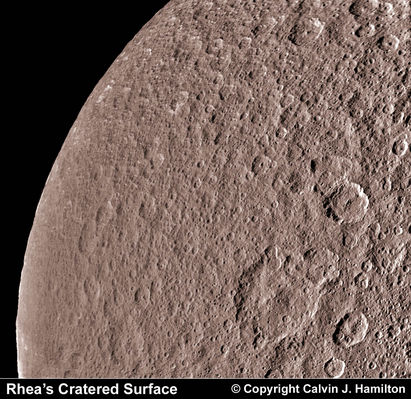
The icy, cratered surface of Saturn's moon Rhea is seen in this HR image taken by Voyager 1 on November 11, 1980, from a distance of about 85.000 Km (such as approx. 52.800 miles) as the spacecraft passed over the Satellite's North Pole. The heavily cratered surface attests to the Satellite's ancient age. The largest craters, 50 to 100 Km across and several Km deep, are freshly preserved in Rhea's icy crust. The craters and landscape resemble those on the Moon and Mercury and are unlike the flattened crater forms that have collapsed in the soft icy crusts of the Jovian moons Callisto, Ganymede and Europa.
Scientists believe that Rhea (which is just 1600 Km - about 995 miles - in diameter, compared to the 5.500 Km of diameter of Ganymede) froze and became rigid, behaving like a rocky surface, very early in its history.
|
|