|
|
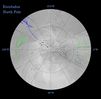
Enceladus: Global Patterns of Fracture (Northern Polar Projection)
|
Terrain near the North Pole is among the most heavily cratered and oldest on the surface of Enceladus. The conspicuously fractured Southern Polar Region is nearly devoid of impact craters, making this terrain among the youngest on the Moon's surface.
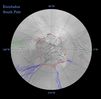
A unique feature of the South Polar terrains is that broad networks of folded or kinked fractures can be found throughout the Region. A prominent "chain" of these fractures (marked in red in the South Polar Map) abruptly separates the youthful South Polar terrains from the older terrains that lie closer to the Equator and appears to encircle the South Pole near about 55° South Latitude.
The wavy boundary of the South Polar terrain is interrupted in numerous places by Y-shaped, or funnel-shaped, discontinuities that curve and taper northward. Well-developed examples of the funnel-shaped discontinuities appear to transition to systems of North-South trending surface cracks (marked in blue).
These north-south trending cracks are best explained as if they formed in response to tension stresses that are parallel to lines of latitude. Such extensional "hoop stresses" would be expected to develop if the equator became wider, perhaps in response to a change in the moon¿s spin rate.
Globally systematic patterns of fracture on Enceladus occur in ancient, cratered terrain as well as youthful terrain. Shown in green on the maps -- and particularly apparent in the northern hemisphere projection -- are roughly orthogonal (or perpendicular) systems of north-south and east-west trending fractures that formed quite close to the tidal axis of Enceladus. The moon¿s tidal axis is a line extending from 0-degrees longitude to 180-degrees longitude. Such orthogonal fractures might have formed in response to tidal stresses exerted on Enceladus by Saturn.
|
|