Inizio Registrati Login

Elenco album Ultimi arrivi Ultimi commenti Più viste Più votate Preferiti Cerca

Inizio > SOLAR SYSTEM > Saturn: the "Ringed Beauty" and His Moons
Ritorna alla pagina delle miniature FILE 1366/2245 Torna all'inizio Guarda foto precedente Guarda foto successiva Salta alla fine
The "Rings' Structure"
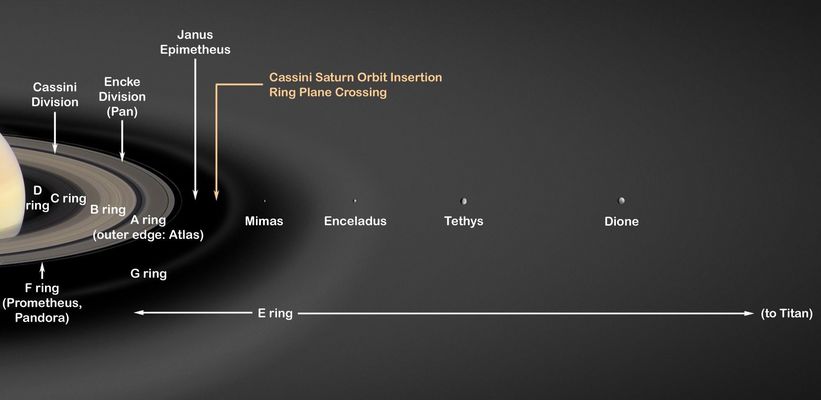
Saturn's Rings make up an enormous, complex structure. From edge-to-edge, the Ring System would not even fit in the distance between Earth and the Moon. The 7 main rings are labeled in the order in which they were discovered. From the planet outward, they are D, C, B, A, F, G and E. The D-Ring is very faint and closest to Saturn. The main Rings are A, B and C. The outermost Ring, easily seen with Earth-based telescopes, is the A-Ring. The Cassini Division is the largest gap in the Rings and separates the B from the A-Ring. Just outside the A-Ring is the narrow F-Ring, shepherded by tiny moons Pandora and Prometheus. Beyond that are 2 much fainter Rings named G and E. Saturn's diffuse E-Ring is the largest planetary ring in our Solar System, extending from Mimas' orbit to Titan's orbit, about 1 MKM.
The particles in Saturn's rings are composed primarily of water ice and range in size from microns to tens of meters. The rings show a tremendous amount of structure on all scales; some of this structure is related to gravitational interactions with Saturn's many moons, but much of it remains unexplained. One moonlet, Pan, actually orbits inside the A ring in a 330-kilometer-wide (200-mile) gap called the Encke Gap. The main rings (A, B and C) are less than 100 meters (300 feet) thick in most places, compared to their radial extent of 62,120 kilometers (38,600 miles). The main rings are much younger than the age of the solar system, perhaps only a few hundred million years old. They may have formed from the breakup of one of Saturn's moons or from a comet or meteor that was torn apart by Saturn's gravity.
Parole chiave: Saturn's Rings

The "Rings' Structure"

Saturn's Rings make up an enormous, complex structure. From edge-to-edge, the Ring System would not even fit in the distance between Earth and the Moon. The 7 main rings are labeled in the order in which they were discovered. From the planet outward, they are D, C, B, A, F, G and E. The D-Ring is very faint and closest to Saturn. The main Rings are A, B and C. The outermost Ring, easily seen with Earth-based telescopes, is the A-Ring. The Cassini Division is the largest gap in the Rings and separates the B from the A-Ring. Just outside the A-Ring is the narrow F-Ring, shepherded by tiny moons Pandora and Prometheus. Beyond that are 2 much fainter Rings named G and E. Saturn's diffuse E-Ring is the largest planetary ring in our Solar System, extending from Mimas' orbit to Titan's orbit, about 1 MKM.
The particles in Saturn's rings are composed primarily of water ice and range in size from microns to tens of meters. The rings show a tremendous amount of structure on all scales; some of this structure is related to gravitational interactions with Saturn's many moons, but much of it remains unexplained. One moonlet, Pan, actually orbits inside the A ring in a 330-kilometer-wide (200-mile) gap called the Encke Gap. The main rings (A, B and C) are less than 100 meters (300 feet) thick in most places, compared to their radial extent of 62,120 kilometers (38,600 miles). The main rings are much younger than the age of the solar system, perhaps only a few hundred million years old. They may have formed from the breakup of one of Saturn's moons or from a comet or meteor that was torn apart by Saturn's gravity.

Rings-PIA08241.jpg Rings-W00004066.jpg RingsStructure-2-PIA03550.jpg SA-Night On Saturn.jpg SATURN by VOYAGER - 1980.jpg
Informazioni sul file
Nome del file:RingsStructure-2-PIA03550.jpg
Nome album:Saturn: the "Ringed Beauty" and His Moons
Valutazione (10 voti):55555(Mostra dettagli)
Parole chiave:Saturn's / Rings
Copyright:NASA/JPL
Dimensione del file:159 KiB
Data di inserimento:Ago 30, 2005
Dimensioni:1989 x 968 pixels
Visualizzato:56 volte
URL:https://www.lunexit.it/gallery/displayimage.php?pid=7113
Preferiti:Aggiungi ai preferiti


Powered by Coppermine Photo Gallery