Inizio Registrati Login

Elenco album Ultimi arrivi Ultimi commenti Più viste Più votate Preferiti Cerca

Inizio > SOLAR SYSTEM > Saturn: the "Ringed Beauty" and His Moons
Ritorna alla pagina delle miniature FILE 422/2245 Torna all'inizio Guarda foto precedente Guarda foto successiva Salta alla fine
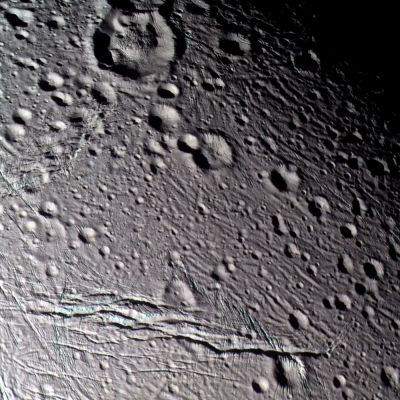
Enceladus' "crispy & fractured" surface (false colors)
To human eyes, Enceladus appears almost completely white, but false color reveals intriguing details. This view is a composite of images taken using filters sensitive to ultraviolet (centered at 338 nnmts), green (centered at 568 nnmts), and near-infrared (centered at 930 nnmts) light and has been processed to accentuate subtle color differences. The uppermost surface of these terrains appears uniformly grey in this picture, suggesting that they are covered with materials of homogeneous composition and grain size. However, the walls of many of the fractures appear to be somewhat bluer than typical surface materials. It is possible that the difference in color identifies outcrops of solid ice on the walls of fractures, or ice with different grain-sizes, compared to powdery surface materials. It is also possible that the color identifies some compositional difference between buried ice and ice at the surface. The surface is peppered with craters of all sizes, from the 21-Km diameter crater at the top of the image, down to tiny craters near the limit of resolution. The prominent crater at the top contains a central, domelike structure more than 11 kilometers (7 miles) in diameter. The dome, the crater -- and indeed the entire scene -- is sliced by a complex network of fractures ranging in width from hundreds of meters in some places, to over three kilometers (2 miles) in others.
Parole chiave: Saturn's Moons - Enceladus

Enceladus' "crispy & fractured" surface (false colors)

To human eyes, Enceladus appears almost completely white, but false color reveals intriguing details. This view is a composite of images taken using filters sensitive to ultraviolet (centered at 338 nnmts), green (centered at 568 nnmts), and near-infrared (centered at 930 nnmts) light and has been processed to accentuate subtle color differences. The uppermost surface of these terrains appears uniformly grey in this picture, suggesting that they are covered with materials of homogeneous composition and grain size. However, the walls of many of the fractures appear to be somewhat bluer than typical surface materials. It is possible that the difference in color identifies outcrops of solid ice on the walls of fractures, or ice with different grain-sizes, compared to powdery surface materials. It is also possible that the color identifies some compositional difference between buried ice and ice at the surface. The surface is peppered with craters of all sizes, from the 21-Km diameter crater at the top of the image, down to tiny craters near the limit of resolution. The prominent crater at the top contains a central, domelike structure more than 11 kilometers (7 miles) in diameter. The dome, the crater -- and indeed the entire scene -- is sliced by a complex network of fractures ranging in width from hundreds of meters in some places, to over three kilometers (2 miles) in others.

Enceladus-PIA06208.jpg Enceladus-PIA06209.jpg Enceladus-PIA06210.jpg Enceladus-PIA06215.jpg Enceladus-PIA06217.jpg
Informazioni sul file
Nome del file:Enceladus-PIA06210.jpg
Nome album:Saturn: the "Ringed Beauty" and His Moons
Valutazione (4 voti):55555(Mostra dettagli)
Parole chiave:Saturn's / Moons / - / Enceladus
Copyright:NASA - Cassini Mission
Dimensione del file:203 KiB
Data di inserimento:Mar 17, 2005
Dimensioni:1000 x 1000 pixels
Visualizzato:55 volte
URL:https://www.lunexit.it/gallery/displayimage.php?pid=4812
Preferiti:Aggiungi ai preferiti


Powered by Coppermine Photo Gallery