|
|
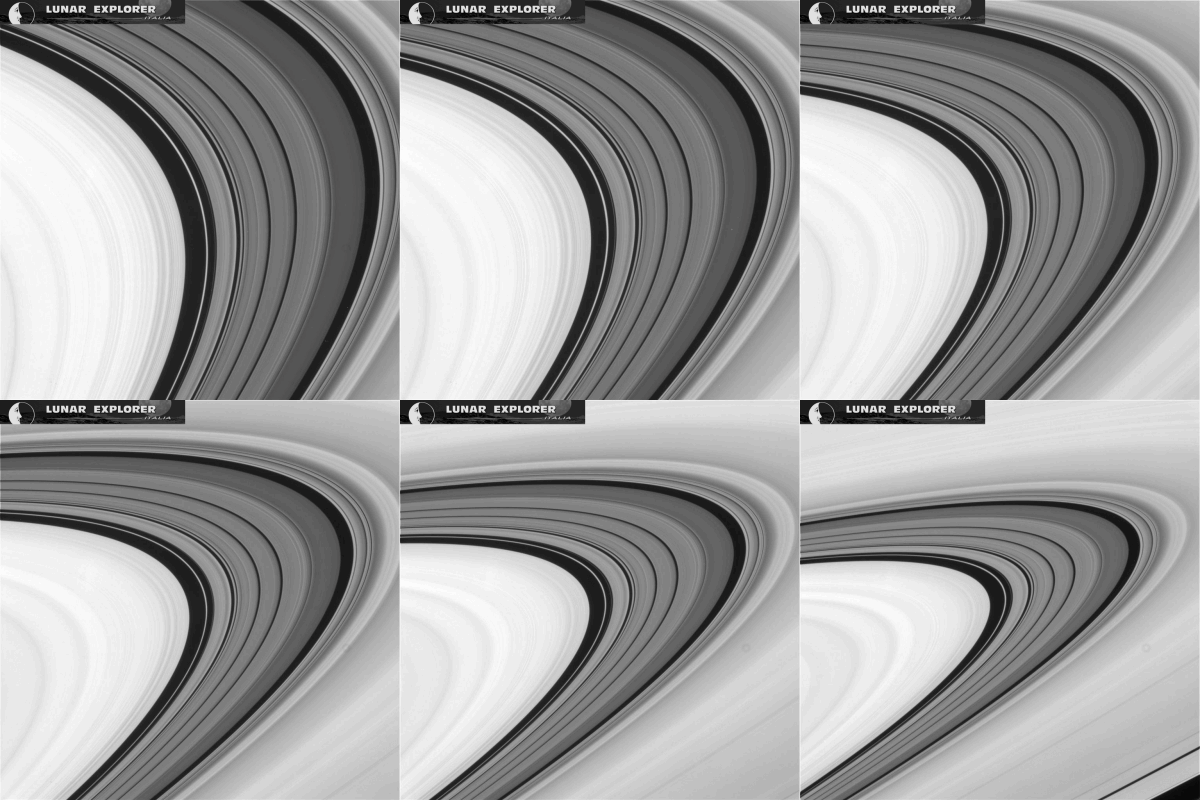
In the Rings (a GIF-Movie by Dr Gianluigi Barca - Lunar Explorer Italia/Italian Planetary Foundation)
|
The densest Regions of the Saturnian Ring System consist of the A and B-Rings, which are separated by the so-called "Cassini Division" (which was discovered in the AD 1675 by the Italian Astronomer Giovanni Domenico Cassini). Along with the C-Ring, which was discovered 75 years later (such as in the AD 1850), these three Regions together form the Main Rings of the Giant Gas Planet Saturn.
The Main Rings are denser and contain larger Water Ice and Rocky Particles than the very tenuous so-called Dusty Rings, which include the D-Ring (extending inward, towards Saturn's Cloud Tops), the G and E-Rings, as well as other and even more tenuous (or also "diffuse") Rings and Ringlets (and, perhaps, even some Ring Arcs) which are all located beyond the three Main Rings (which can also be named as the "Main Ring System").
These "Diffuse Rings" are known as "dusty" because of the extremely small size of the Water Ice and Dust Particles which form them (and whose size can often be in the order of just one or two micrometers). Last, but not least, the narrow F-Ring - which rotates just off the Outer Edge of the A-Ring - is the most difficult one to be categorized, and that is because some parts of it are very dense, while others are extremely tenuous.
The brightness and purity of the Water Ice contained in the Rings has been often cited as evidence that they should (and could very well be) much younger than Saturn (some Scientists say - but this is, of course, just a speculation - that their age could be of approx. 100 Million Years only, since the infall of Meteoric Dust would have led to some very obvious darkening of the Rings themselves, if they had been older. However, a new research also indicates that the B-Ring may be massive enough to have diluted the infalling Meteoric Dust Material and thus avoided any substantial darkening of the entire Ring System. In addition to the above, the material forming the Rings may also be periodically recycled, as "Clumps" form within the Rings and then are disrupted by occasional Impacts. This last theory, if proven correct, could substantially explain the apparent youth of some of the Material existing within the whole Ring System.
The NASA - Cassini - UVIS Team, led by Dr Larry Esposito, used the so-called "Stellar Occultation Method" to discover something like 13 (thirteen) new Celestial Objects, ranging from approx. 27 metres to about 10 Km across, and all located within the F-Ring. These Objects appear to be translucent, thus suggesting that they could be temporary aggregates of Water Ice Boulders, each one of them being a few meters across. Dr Esposito believes that this could be the Basic (Mechanical) Structure that allows the formation and (somehow periodic) renewal of the entire Saturnian Ring System, such as Water Ice and Rocky Dust Particles first clumping together, and then being - as we suggested, maybe occasionally, maybe periodically - blasted apart.
|
|