|
|
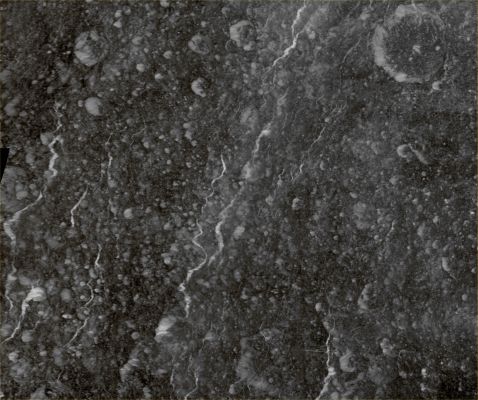
The Heavily Fractured Surface of Rhea (Absolute Natural Colors; credits for the additional process. and color.: Dr Paolo C. Fienga - Lunexit Team)
|
Caption NASA:"Icy Fractures on Saturn's moon Rhea reflect Sunlight brightly in this High-Resolution Mosaic created from images captured by NASA's Cassini Spacecraft during its March 2, 2010, Fly-By. This Fly-By was the closest one of Rhea up to then.
This mosaic of six images shows the Westernmost portion of the moon's "Wispy" Terrain. Among the interesting features depicted here is a very straight East-West Fracture near the top center of the mosaic that intersects two North-South Fractures. The large Crater at the bottom left of the mosaic is Inmar Crater (about 55 Km, or approx. 34 miles across).
The closest approach of the Spacecraft to Rhea during this encounter was of about 100 Km (approx. 62 miles). These images were obtained approximately 30 minutes later, at an altitude of about 16.000 Km (roughly 10.000 miles).
This mosaic shows part of the side of Rhea that always faces Saturn. The images were re-projected in an orthographic projection centered on Terrain at 7° North Latitude and 296° West Longitude. The mosaic itself shows Features centered on Terrain that is at 6° North Latitude and 293° West Longitude.
The images were taken with the Cassini Spacecraft narrow-angle camera. The view was obtained at a Sun-Rhea-Spacecraft, or Phase, Angle of about 2°. So, Cassini was almost directly between Rhea and the Sun as it acquired these images.
Image scale is roughly 85 meters (280 feet) per pixel".
|
|