|
|
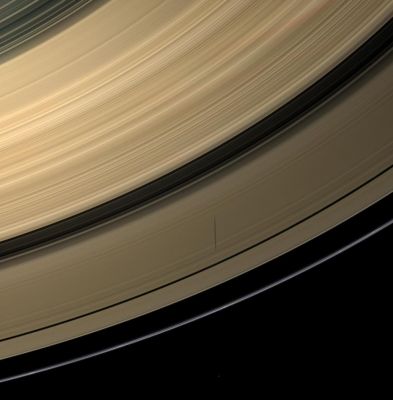
Within the Rings (Natural Colors; credits: NASA/JPL/Space Science Institute)
|
Caption NASA:"Saturn's moon Epimetheus casts a shadow across the colourful Rings of Saturn, in this image taken before the Planet's August 2009 Equinox.
Epimetheus (approx. 113 Km, or about 70 miles across) is visible as a small dot at the center of the bottom of the image.
The novel illumination geometry that accompanies Equinox lowers the Sun's angle to the Ring-Plane, significantly darkens the Rings, and causes out-of-plane structures to look anomalously bright and cast shadows across the Rings. These scenes are possible only during the few months before and after Saturn's Equinox, which occurs only once in about 15 Earth years. Before and after Equinox, Cassini's cameras have spotted not only the predictable shadows of some of Saturn's moons (see PIA11657), but also the shadows of newly revealed Vertical Structures in the Rings themselves (see PIA11665).
Images taken using red, green and blue spectral filters were combined to create this Natural Color view. This view looks toward the southern, sunlit side of the Rings from about 39° below the Ring-Plane.
The images were obtained with the Cassini Spacecraft wide-angle camera on June 8, 2009 at a distance of approx. 725.000 Km (about 450.000 miles) from Saturn.
Image scale is roughly 40 Km (about 25 miles) per pixel".
|
|










questa ve la scrivo così, di getto, stasera (che sono stanco morto), perchè ho la sensazione che fra non molto la notizia diventerà "ufficiale" ed io non vorrei vedermi "scippato" il frutto di ore ed ore di riflessioni ed ipotesi.
Allora: la NASA parla di "Vertical Structures" negli Anelli di Saturno. Che cosa sono?
O meglio: che cosa significano? Secondo me significano che, nelle ere, una porzione del materiale che forma gli Anelli di Saturno si è gravitazionalmente aggregata, formando una superficie unitaria, compatta, leggera e fragile ma, tutto sommato, abbastanza resistente da poter sopportare la presenza (rectius: il "peso") di rilievi su di essa.
Avete presente le "cialde" fatte con la paste dei biscotti? Stessa cosa.
Nei milioni/miliardi di anni durante i quali "innumerevoli (diciamo "infiniti", convenzionalmente) corpuscoli di roccia - ravvicinati MA isolati - hanno orbitato sincronicamente" intorno al Pianeta Genitore, si sono verificate delle (a quanto pare comuni, nell'Universo) "aggregazioni" (pensate, se volete trovare un qualcosa di affine, alla struttura fisica degli Asteroidi 433-Eros ed Itokawa) le quali sono giunte a creare delle "lastre di superficie omogenea e compatta" che, simile ad un "pavimento", forma delle (ritengo) vaste regioni degli Anelli di Saturno.
In altre parole, gli Anelli di Saturno - a mio modestissimo (ma ragionato ed informato) parere - NON SONO una "nuvola di detriti più o meno grandi (o piccoli) che orbitano sincronicamente attorno al Pianeta" (come dicono TUTTI gli Astronomi e gli Astrofisici), bensì sono una (cosiddetta) "Struttura COMPLESSA (o a Matrice Multipla)".
Una Struttura, quindi, in parte solida, unitaria e compatta (ergo fatta di/costituita da lastroni di materiale aggregatosi gravitazionalmente nelle ere e su cui sorgono anche dei rilievi - di modestissime dimensioni (ECCO le Vertical Structures!) - ed in parte (ancora) nebulare.
Secondo me, non ci voleva nè ci vuole un "genio" per arrivare a questa ragionevolissima conclusione la quale, oltre che accettabile da un punto di vista squisitamente fisico, è pure suffragata da un (ormai) enorme volume di evidenze dirette.
Buonanotte a Tutti! PCF
marco
E questo, sempre probabilmente, ha infastidito qualcuno...
Per quanto riguarda l'idea di Titanio (...materia sottoposta ad una Termodinamica Locale...), in ordine alle "Vertical Structures", mi piace. Mi intriga! Ma richiede tempo, per essere sviluppata e quindi...ne riparleremo.
Per chiudere, due parole sulla "correttezza" a cui fa riferimento Titanio44: secondo me, è un Valore. E, a quanto vedo e leggo sulle nostre pagine, è un Valore anche per TUTTI Voi.
Ma "fuori" dal Mondo Lunexit, "out there", come diceva Fox Mulder, io di Correttezza ne vedo poca. Pochissima. Quasi nulla.
Vedo tanti squali e tanti furbacchioni. E vedo - purtroppo - anche tanta ignoranza. In parte inevitabile, ma in parte voluta, rigorosamente, dall'establishment scientifico.
E mi fermo qui. - PCF