Inizio Registrati Login

Elenco album Ultimi arrivi Ultimi commenti Più viste Più votate Preferiti Cerca

Inizio > SOLAR SYSTEM > Saturn: the "Ringed Beauty" and His Moons
Ritorna alla pagina delle miniature FILE 892/2245 Torna all'inizio Guarda foto precedente Guarda foto successiva Salta alla fine
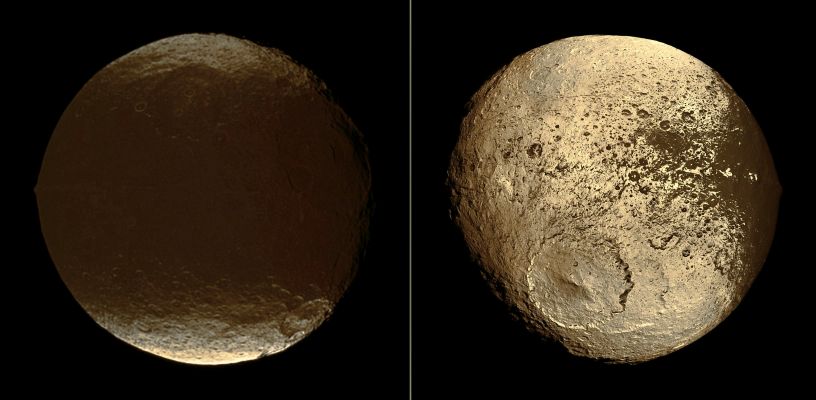
Global View of Japetus' "Brightness Dichotomy" (Approx. True Colors; credits: Lunexit)
Caption NASA:"These two global images of Japetus show the extreme brightness dichotomy on the Surface of this peculiar Saturnian moon. The left-hand panel shows Japetus' Leading Hemisphere and the right-hand panel shows its Trailing Side. While Low and Mid Latitudes of the Leading Side exhibit a Surface almost as dark as charcoal, broad tracts of the Trailing Side are almost as bright as snow. 
The dark terrain covers about 40% of the Surface of Japetus and it has been named "Cassini Regio". The names of the bright terrain are Roncevaux Terra (North) and Saragossa Terra (South). 

On both Hemispheres, the dominant landforms are impact craters. The largest known well-preserved basin on Japetus, called "Turgis", has a diameter of about 580 Km (approx. 360 miles). It lies at 17° North Latitude and 28° West Long., at the Eastern Edge of the Cassini Regio and is visible on the right side of the left-hand panel. The prominent basin on the Southern Trailing Side (at the lower left of the right-hand panel) is named Engelier. 
Engelier is located at 41° South Latitude and 265° West Longitude, and it has a diameter of about 504 Km (such as approx. 313 miles). 
Its formation destroyed about half of Gerin, another large basin on Japetus. Gerin is located at 46° South Latitude and 233° West Longitude; it has a diameter of about 445 Km (approx. 276 miles). 

Tortelosa Montes, a part of the giant Equatorial Ridge that was discovered in Cassini images on December 25, 2004, is visible in the left panel as a thin line within Cassini Regio, and as a tall prominence at the Western Limb. It continues onto the Trailing Side (right side of right panel), where the bright Western Flanks of the Carcassone Montes appear as dominant bright spots within the Western Edge of Cassini Regio. 

The cause of the extreme brightness dichotomy on Japetus is likely to be "thermal segregation of water ice" on a global scale. 
Thermal effects are usually expected to act latitudinally. 
That is, Polar Areas are colder than Equatorial Terrain in most cases due to the more oblique angle of the Solar Irradiation. Therefore, an additional process is required to explain the longitudinal difference as well. 

In one model, dark, reddish dust coming in from space and preferentially deposited on the Leading Side forms a small, but crucial difference between the Leading and Trailing Hemispheres, which is sufficient to allow the thermal effect to evaporate the water ice on the Leading Side completely, but only marginally on the Trailing Side. (see PIA11689 to learn more) 

Japetus' extremely slow Rotation Rate (about 1 hour and 54 minutes), its distance from the Sun, its relatively small size and Surface Gravity and its outer position within the regular satellite system of Saturn are also crucial contributing conditions for this mechanism to work as observed. 

North on Japetus is approx. up in the images. Japetus has a diameter of about 1471 Km (approx. 914 miles). 

The right-hand panel, released previously as PIA08384, shows a mosaic of 60 different images, obtained on September 10, 2007. 

The left-hand panel is a color composite of three images obtained through InfraRed, Green and UltraViolet Spectral Filters (centered at 752, 568 and 338 nanometers, respectively) by Cassini's narrow-angle camera on Dec. 27, 2004. 
The view was acquired at a distance of approx. 717.000 Km (about 446.000 miles) from Japetus and at a Sun-Japetus-Spacecraft, or Phase, Angle of 22°. 

Scale in the original image on the left was about 4 Km (approx. 2,5 miles) per pixel. For ease of comparison, the scales in both the left and right images were set to 1400 meters (such as 4600 feet) per pixel".
Parole chiave: Saturn's Moon - Japetus

Global View of Japetus' "Brightness Dichotomy" (Approx. True Colors; credits: Lunexit)

Caption NASA:"These two global images of Japetus show the extreme brightness dichotomy on the Surface of this peculiar Saturnian moon. The left-hand panel shows Japetus' Leading Hemisphere and the right-hand panel shows its Trailing Side. While Low and Mid Latitudes of the Leading Side exhibit a Surface almost as dark as charcoal, broad tracts of the Trailing Side are almost as bright as snow.
The dark terrain covers about 40% of the Surface of Japetus and it has been named "Cassini Regio". The names of the bright terrain are Roncevaux Terra (North) and Saragossa Terra (South).

On both Hemispheres, the dominant landforms are impact craters. The largest known well-preserved basin on Japetus, called "Turgis", has a diameter of about 580 Km (approx. 360 miles). It lies at 17° North Latitude and 28° West Long., at the Eastern Edge of the Cassini Regio and is visible on the right side of the left-hand panel. The prominent basin on the Southern Trailing Side (at the lower left of the right-hand panel) is named Engelier.
Engelier is located at 41° South Latitude and 265° West Longitude, and it has a diameter of about 504 Km (such as approx. 313 miles).
Its formation destroyed about half of Gerin, another large basin on Japetus. Gerin is located at 46° South Latitude and 233° West Longitude; it has a diameter of about 445 Km (approx. 276 miles).

Tortelosa Montes, a part of the giant Equatorial Ridge that was discovered in Cassini images on December 25, 2004, is visible in the left panel as a thin line within Cassini Regio, and as a tall prominence at the Western Limb. It continues onto the Trailing Side (right side of right panel), where the bright Western Flanks of the Carcassone Montes appear as dominant bright spots within the Western Edge of Cassini Regio.

The cause of the extreme brightness dichotomy on Japetus is likely to be "thermal segregation of water ice" on a global scale.
Thermal effects are usually expected to act latitudinally.
That is, Polar Areas are colder than Equatorial Terrain in most cases due to the more oblique angle of the Solar Irradiation. Therefore, an additional process is required to explain the longitudinal difference as well.

In one model, dark, reddish dust coming in from space and preferentially deposited on the Leading Side forms a small, but crucial difference between the Leading and Trailing Hemispheres, which is sufficient to allow the thermal effect to evaporate the water ice on the Leading Side completely, but only marginally on the Trailing Side. (see PIA11689 to learn more)

Japetus' extremely slow Rotation Rate (about 1 hour and 54 minutes), its distance from the Sun, its relatively small size and Surface Gravity and its outer position within the regular satellite system of Saturn are also crucial contributing conditions for this mechanism to work as observed.

North on Japetus is approx. up in the images. Japetus has a diameter of about 1471 Km (approx. 914 miles).

The right-hand panel, released previously as PIA08384, shows a mosaic of 60 different images, obtained on September 10, 2007.

The left-hand panel is a color composite of three images obtained through InfraRed, Green and UltraViolet Spectral Filters (centered at 752, 568 and 338 nanometers, respectively) by Cassini's narrow-angle camera on Dec. 27, 2004.
The view was acquired at a distance of approx. 717.000 Km (about 446.000 miles) from Japetus and at a Sun-Japetus-Spacecraft, or Phase, Angle of 22°.

Scale in the original image on the left was about 4 Km (approx. 2,5 miles) per pixel. For ease of comparison, the scales in both the left and right images were set to 1400 meters (such as 4600 feet) per pixel".

Japetus-PIA11632.jpg Japetus-PIA11689.jpg Japetus-PIA11690.jpg Japetus-PIA12521.jpg Japetus-PIA12539.jpg
Informazioni sul file
Nome del file:Japetus-PIA11690.jpg
Nome album:MareKromium / Saturn: the "Ringed Beauty" and His Moons
Valutazione (3 voti):55555(Mostra dettagli)
Parole chiave:Saturn's / Moon / - / Japetus
Copyright:NASA/JPL/Space Science Institute e Lunar Explorer Italia per il processing addizionale e la colorizzazione
Dimensione del file:849 KiB
Data di inserimento:Dic 18, 2009
Dimensioni:4080 x 2000 pixels
Visualizzato:62 volte
URL:https://www.lunexit.it/gallery/displayimage.php?pid=25967
Preferiti:Aggiungi ai preferiti


Powered by Coppermine Photo Gallery