Inizio Registrati Login

Elenco album Ultimi arrivi Ultimi commenti Più viste Più votate Preferiti Cerca

Inizio > SOLAR SYSTEM > Saturn: the "Ringed Beauty" and His Moons
Ritorna alla pagina delle miniature FILE 522/2245 Torna all'inizio Guarda foto precedente Guarda foto successiva Salta alla fine
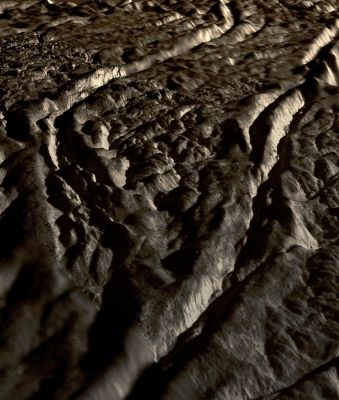
Perspective view of Baghdad Sulcus, Enceladus (Natural Colors; credits: Lunexit)
This perspective view of Baghdad Sulcus was generated using high resolution images of Enceladus acquired in August 2008 at 12 to 30 meters (40 to 100 feet) resolution, together with a new topographic map of the region produced by Dr. Paul Schenk (http://www.lpi.usra.edu/lpi/schenk/) at the Lunar and Planetary Institute in Houston, TX. Lower resolution images to either side were acquired at 50 to 80 meter (165 to 260 feet) resolution. 

Baghdad Sulcus is one of several prominent linear structures, dubbed “Tiger Stripes”, within the geologically active South Polar Region of Enceladus. This view shows a wedge-shaped area between two prominent branches of Baghdad Sulcus. Each branch consists of two large parallel ridges up to 2 Km (approx. 1,2 mile) across separated by a deep V-shaped medial trough. 
The ridges are 80 to 100 meters (approximately 260 to 325 feet) high. The medial troughs between the ridges are 200 to 250 meters (650 to 820 feet) deep. The maximum separation between the two branches is about 12 Km (about 7.5 miles). 
Troughs such as those shown here are probably the source of numerous jets making up the large active water vapor plume over the South Pole of Enceladus. The floors of the medial troughs are often broken up into smaller ridges. These could be blocks of crust that have slid down the walls of the trough or fractured blocks pushed up from below. Relief has been exaggerated by a factor of ~10 to enhance clarity. 

The raw data from which this product was developed were retrieved from the Planetary Data System's Cassini archives. The Cassini-Huygens mission is a cooperative project of NASA, the European Space Agency and the Italian Space Agency. The Jet Propulsion Laboratory, a division of the California Institute of Technology in Pasadena, manages the mission for NASA's Science Mission Directorate, Washington, D.C. The Cassini orbiter and its two onboard cameras were designed, developed and assembled at JPL. The imaging operations center is based at the Space Science Institute in Boulder, Colo. (http://ciclops.org)
Parole chiave: Saturn's Moon - Enceladus

Perspective view of Baghdad Sulcus, Enceladus (Natural Colors; credits: Lunexit)

This perspective view of Baghdad Sulcus was generated using high resolution images of Enceladus acquired in August 2008 at 12 to 30 meters (40 to 100 feet) resolution, together with a new topographic map of the region produced by Dr. Paul Schenk (http://www.lpi.usra.edu/lpi/schenk/) at the Lunar and Planetary Institute in Houston, TX. Lower resolution images to either side were acquired at 50 to 80 meter (165 to 260 feet) resolution.

Baghdad Sulcus is one of several prominent linear structures, dubbed “Tiger Stripes”, within the geologically active South Polar Region of Enceladus. This view shows a wedge-shaped area between two prominent branches of Baghdad Sulcus. Each branch consists of two large parallel ridges up to 2 Km (approx. 1,2 mile) across separated by a deep V-shaped medial trough.
The ridges are 80 to 100 meters (approximately 260 to 325 feet) high. The medial troughs between the ridges are 200 to 250 meters (650 to 820 feet) deep. The maximum separation between the two branches is about 12 Km (about 7.5 miles).
Troughs such as those shown here are probably the source of numerous jets making up the large active water vapor plume over the South Pole of Enceladus. The floors of the medial troughs are often broken up into smaller ridges. These could be blocks of crust that have slid down the walls of the trough or fractured blocks pushed up from below. Relief has been exaggerated by a factor of ~10 to enhance clarity.

The raw data from which this product was developed were retrieved from the Planetary Data System's Cassini archives. The Cassini-Huygens mission is a cooperative project of NASA, the European Space Agency and the Italian Space Agency. The Jet Propulsion Laboratory, a division of the California Institute of Technology in Pasadena, manages the mission for NASA's Science Mission Directorate, Washington, D.C. The Cassini orbiter and its two onboard cameras were designed, developed and assembled at JPL. The imaging operations center is based at the Space Science Institute in Boulder, Colo. (http://ciclops.org)

Enceladus-PIA12082.jpg Enceladus-PIA12207.jpg Enceladus-PIA12208.jpg Enceladus-PIA12209.jpg Enceladus-PIA12517.jpg
Informazioni sul file
Nome del file:Enceladus-PIA12208.jpg
Nome album:MareKromium / Saturn: the "Ringed Beauty" and His Moons
Valutazione (2 voti):55555(Mostra dettagli)
Parole chiave:Saturn's / Moon / - / Enceladus
Copyright:NASA/JPL/Space Science Institute e Lunar Explorer Italia per il processing addizionale e la colorizzazione
Dimensione del file:227 KiB
Data di inserimento:Set 25, 2009
Dimensioni:1104 x 1300 pixels
Visualizzato:54 volte
URL:https://www.lunexit.it/gallery/displayimage.php?pid=25363
Preferiti:Aggiungi ai preferiti

Commento 1 a 3 di 3
Pagina: 1

Anakin   [Set 25, 2009 at 12:56 PM]
Che Forza!! Ma Cassini arrivata cos vicino?
MareKromium   [Set 25, 2009 at 04:11 PM]
Cassini ha letteralmente "sfiorato" Encelado, passando a circa 500 Km di distanza dalla sua superficie. Questa immagine una ricostruzione prospettica di una delle Tiger Stripes, ottenuta da frames Cassini interpolati (in altre parole: non un'immagine "vera", ma un'immagine "realistica"). Una giusta precisazione a fronte di una giusta domanda. - PCF
Anakin   [Set 25, 2009 at 09:46 PM]
Si pu dire che potrebbe essere poco affidabile come le elaborazioni ESA relativamente a Marte?

Commento 1 a 3 di 3
Pagina: 1


Powered by Coppermine Photo Gallery