Inizio Registrati Login

Elenco album Ultimi arrivi Ultimi commenti Più viste Più votate Preferiti Cerca

Inizio > SOLAR SYSTEM > Saturn: the "Ringed Beauty" and His Moons
Ritorna alla pagina delle miniature FILE 519/2245 Torna all'inizio Guarda foto precedente Guarda foto successiva Salta alla fine
Enceladus' Ice-Plume Models
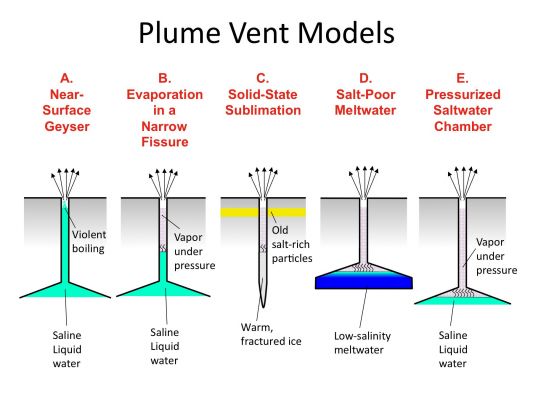
Caption NASA:"These illustrations indicate possible ways in which the water vapor and ice particles in the plume of Enceladus may be formed. The Cassini spacecraft recently found a small fraction of salt-rich ice particles from the plumes, while Earth-based observations indicate gas from the plumes is very poor in sodium. These measurements are helping scientists to evaluate how the plumes form. 

In model A, salty water boils explosively near the surface of Enceladus when it encounters the vacuum of space. This model can be ruled out, because such explosive activity would spread large amounts of sodium into space where it would have been seen by the Earth-based observers. If this model was correct, then nearly all the ice particles observed by Cassini would be salt-rich, instead of just a fraction of them. 

In model B, salty water evaporates more slowly at some depth in a narrow fissure, creating vapor which escapes to the surface to form the plume. This model also seems unlikely because the fissure would rapidly become clogged by salt left behind as water evaporates. The water would also freeze, because not enough heat could reach the water surface up the narrow fissure to replace the heat lost by evaporation. 

In model C, the warm ice evaporates directly into vapor to form the plume, in a process called sublimation. The salty particles found in the plume would have been created by liquid water in an earlier epoch and would have been stored in the near-surface layers of Enceladus until the present. These particles would now be incorporated into the plume by the escaping gases. This model cannot be ruled out, but seems unlikely because it may be difficult to dislodge old ice grains from the walls of the fracture. 

In model D, the liquid water results from melting of near-surface ice rather than coming from an underlying salty ocean. The water is initially only slightly salty, but its salinity increases as evaporation removes some of the water and leaves the salt behind. Thus, in this model, the salt-rich ice particles seen by Cassini would be derived from initially salt-poor water. This model may be plausible and has not yet been evaluated in detail. 

In model E, the water is originally salty, and perhaps comes from a subsurface ocean in contact with an underlying rocky core. The water evaporates slowly into a pressurized chamber, from which water vapor and ice particles, including salty particles from the salt water, escape to the surface along narrow fissures. The large area of the evaporating water surface prevents accumulated salt from clogging the vent and allows enough heat to reach the water surface from below to prevent the water from freezing. This model seems he simplest, and perhaps most likely of the models shown here, but is not the only possibility. Enceladus' plumes may involve a combination of several of these idealized models".
Parole chiave: Technical Drawings

Enceladus' Ice-Plume Models

Caption NASA:"These illustrations indicate possible ways in which the water vapor and ice particles in the plume of Enceladus may be formed. The Cassini spacecraft recently found a small fraction of salt-rich ice particles from the plumes, while Earth-based observations indicate gas from the plumes is very poor in sodium. These measurements are helping scientists to evaluate how the plumes form.

In model A, salty water boils explosively near the surface of Enceladus when it encounters the vacuum of space. This model can be ruled out, because such explosive activity would spread large amounts of sodium into space where it would have been seen by the Earth-based observers. If this model was correct, then nearly all the ice particles observed by Cassini would be salt-rich, instead of just a fraction of them.

In model B, salty water evaporates more slowly at some depth in a narrow fissure, creating vapor which escapes to the surface to form the plume. This model also seems unlikely because the fissure would rapidly become clogged by salt left behind as water evaporates. The water would also freeze, because not enough heat could reach the water surface up the narrow fissure to replace the heat lost by evaporation.

In model C, the warm ice evaporates directly into vapor to form the plume, in a process called sublimation. The salty particles found in the plume would have been created by liquid water in an earlier epoch and would have been stored in the near-surface layers of Enceladus until the present. These particles would now be incorporated into the plume by the escaping gases. This model cannot be ruled out, but seems unlikely because it may be difficult to dislodge old ice grains from the walls of the fracture.

In model D, the liquid water results from melting of near-surface ice rather than coming from an underlying salty ocean. The water is initially only slightly salty, but its salinity increases as evaporation removes some of the water and leaves the salt behind. Thus, in this model, the salt-rich ice particles seen by Cassini would be derived from initially salt-poor water. This model may be plausible and has not yet been evaluated in detail.

In model E, the water is originally salty, and perhaps comes from a subsurface ocean in contact with an underlying rocky core. The water evaporates slowly into a pressurized chamber, from which water vapor and ice particles, including salty particles from the salt water, escape to the surface along narrow fissures. The large area of the evaporating water surface prevents accumulated salt from clogging the vent and allows enough heat to reach the water surface from below to prevent the water from freezing. This model seems he simplest, and perhaps most likely of the models shown here, but is not the only possibility. Enceladus' plumes may involve a combination of several of these idealized models".

Enceladus-PIA11697.jpg Enceladus-PIA12080.jpg Enceladus-PIA12081.jpg Enceladus-PIA12082.jpg Enceladus-PIA12207.jpg
Informazioni sul file
Nome del file:Enceladus-PIA12081.jpg
Nome album:MareKromium / Saturn: the "Ringed Beauty" and His Moons
Valutazione (1 voti):55555(Mostra dettagli)
Parole chiave:Technical / Drawings
Copyright:NASA/JPL/SWRI/University of Colorado
Dimensione del file:175 KiB
Data di inserimento:Giu 25, 2009
Dimensioni:1800 x 1350 pixels
Visualizzato:70 volte
URL:https://www.lunexit.it/gallery/displayimage.php?pid=24745
Preferiti:Aggiungi ai preferiti


Powered by Coppermine Photo Gallery