|
|
Axial Discontinuity on Enceladus
|
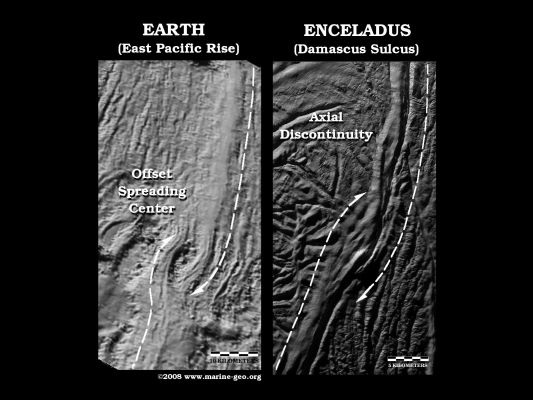
Caption NASA:"These two side-by-side images compare a "twisted" sea-floor spreading feature on Earth, known as an Offset Spreading Center (OSC), to a very similar looking twisted break, or Axial Discontinuity, in the Damascus Sulcus "Tiger Stripe" on Saturn’s moon Enceladus. The image of Enceladus was acquired by NASA’s Cassini Spacecraft imaging science sub-system during one of its four close targeted flybys of Enceladus in March, August and October 2008.
The image on the left shows a shaded relief map of bathymetry (or sonar-like topography) data along a spreading ridge on the East Pacific Rise near 9,5° North Lat. and 104° West Long.
On Earth, OSC's occur only along fast-spreading ridges - ones that spread faster than about 100 mm (such as 4") per year. They do not occur on slow-spreading ridges, like the famous Mid-Atlantic Ridge where spreading rates are often less than 20 mm (0,7") per year.
The Axial Discontinuity on Enceladus’ Damascus Sulcus, shown in the image on the right, twists in the same helical way that the OSC does on Earth. However, the morphological resemblance is no guarantee that both features are caused by fast spreading.
On Earth OSCs form when two nearly parallel spreading ridges lengthen along their ridge (or long) axes. As the lengthening tips of the ridges pass each other side-by-side in opposite directions, shear forces caused by tectonic spreading between them force the two tips to twist around each other. The twisting tip of each one eventually merges with the "neck" of the other in a "yin-yang" shaped pattern.
The result is an oval shaped basin that is surrounded by the twisted ridge tips.
On Enceladus, the twisted features have not produced an oval basin, but the pattern of the twist is very similar to the terrestrial OSC and probably similar tectonic shear forces, perhaps even tectonic spreading, resulted in this twisted shape. Note that the Enceladus image has been flipped right-to-left to make comparison to the sea-floor feature easier to see".
|
|