|
|
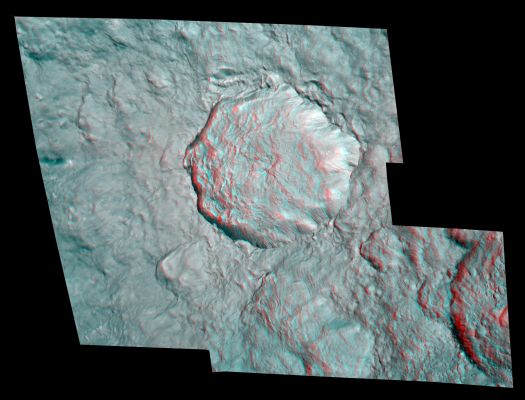
Rayed Crater on Rhea (3D)
|
Rhea's surface gains some depth in this stereo image, or anaglyph, which features the bright and geologically young-looking rayed crater on the moon's Leading Hemisphere. The view was created from images taken during Cassini's close encounter with Rhea on Aug. 30, 2007.
The crater is about 48 Km (approx. 30 miles) wide, and its rays extend several hundred kilometers outward. The rim of this crater is quite sharply defined, and there are few small craters overprinted onto it. These characteristics, along with the brightness of the crater and its rays are indicative of a feature formed relatively recently in geologic history.
The hummocky floor of the crater possesses a central peak and clusters of small craters. The little craters may be secondary impact sites, formed by ejecta from the primary impact that landed in the crater, or they could have been formed by material that had broken off of the body that struck Rhea.
This stereo image is a mosaic consisting of seven Cassini spacecraft narrow-angle camera images. The view is an orthographic projection centered on 12° South Latitude, 112° West Longitude and has a resolution of 45 meters (148 feet) per pixel. An orthographic view is most like the view seen by a distant observer looking through a telescope. North is up.
The clear filter images for this stereo image were taken from distances ranging from about 17.000 Km (approx. 10.600 miles, for the red-colored image) to 7.500 Km (such as about 4.700 miles, for the blue/green-colored image) from Rhea.
|
|