|
|
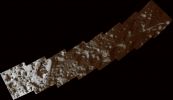
The "Transition Region of Japetus" (possible natural colors - elab. Lunexit)
|
The Transition Region from Saturn's moon Japetus' dark Leading Hemisphere to its bright Trailing Hemisphere is a complicated patchwork of craters and highlands, with low elevations filled in by dark material.
An explanation of the pattern visible here might be key to a full understanding of the bright/dark dichotomy on Japetus (about 1468 Km across).
The view is centered on the Equator and covers an area 711 Km wide by 417 Km tall (such as about 442 x 259 miles).
The giant Equatorial Ridge visible on the dark Leading Hemisphere is not present anymore in this Region. Instead, large, isolated mountains more than 10 Km tall are spread along the Equator. These mountains show bright western flanks, while the surrounding lowlands are generally dark.
This mosaic is an orthographic projection consisting of 21 image footprints across the surface of Japetus. The view is centered on terrain near 0,1° North Latitude and 199° West Longitude, in the quadrant of Japetus that faces away from Saturn. Image scale is approx. 83 meters (272 feet) per pixel. An orthographic view is most like the view seen by a distant observer looking through a telescope.
The clear spectral filter images in this mosaic were obtained with the Cassini spacecraft narrow- angle camera on Sept. 10, 2007, at distances ranging from 13.857 to 21.846 Km (such as about 8.610 to 13.574 miles) from Japetus.
|
|