Inizio Registrati Login

Elenco album Ultimi arrivi Ultimi commenti Più viste Più votate Preferiti Cerca

Inizio > DEEP SKY > Deep Sky Objects
Ritorna alla pagina delle miniature FILE 153/1036 Torna all'inizio Guarda foto precedente Guarda foto successiva Salta alla fine
Cygnus X-1 and Cygnus OB3
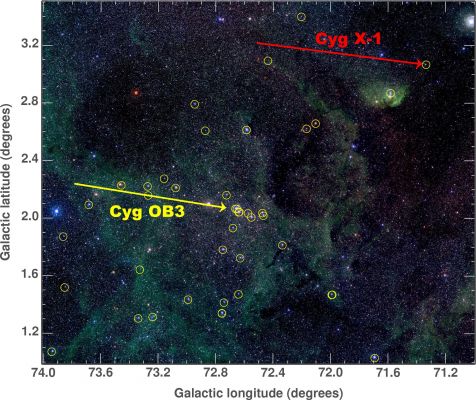
Da "NASA - Picture of the Day" del 2 Aprile 2005:"The formation of a Black Hole from the collapsing core of a massive star is thought to be heralded by a spectacular supernova explosion. Such an extremely energetic collapse is also a leading explanation for the mysterious cosmic Gamma-Ray bursts. But Researchers now suggest that the Milky Way's most famous black hole, Cyg X-1, was born when a massive star collapsed without any supernova explosion at all. Their dynamical evidence is summarized in this color image of a region in Cygnus, showing Cyg X-1 and a cluster of massive stars (yellow circles) known as Cygnus OB3. Arrows compare the measured direction and speed of Cyg X-1 and the average direction and speed of the massive stars of Cyg OB3. The similar motions indicate that Cyg X-1's progenitor star was itself a cluster member and that its path was not altered at all when it became a Black Hole. In contrast, if Cyg X-1 were born in a violent supernova it would have likely received a fierce kick, changing its course. If not a supernova, could the formation of the Cyg X-1 black hole have produced a dark gamma-ray burst in the Milky Way? ".
Parole chiave: From Earth Images

Cygnus X-1 and Cygnus OB3

Da "NASA - Picture of the Day" del 2 Aprile 2005:"The formation of a Black Hole from the collapsing core of a massive star is thought to be heralded by a spectacular supernova explosion. Such an extremely energetic collapse is also a leading explanation for the mysterious cosmic Gamma-Ray bursts. But Researchers now suggest that the Milky Way's most famous black hole, Cyg X-1, was born when a massive star collapsed without any supernova explosion at all. Their dynamical evidence is summarized in this color image of a region in Cygnus, showing Cyg X-1 and a cluster of massive stars (yellow circles) known as Cygnus OB3. Arrows compare the measured direction and speed of Cyg X-1 and the average direction and speed of the massive stars of Cyg OB3. The similar motions indicate that Cyg X-1's progenitor star was itself a cluster member and that its path was not altered at all when it became a Black Hole. In contrast, if Cyg X-1 were born in a violent supernova it would have likely received a fierce kick, changing its course. If not a supernova, could the formation of the Cyg X-1 black hole have produced a dark gamma-ray burst in the Milky Way? ".

Cygnus Starfield.jpg Cygnus.jpg CygnusX1.jpg Cygnus_Region.jpg Cygnus_Region~0.jpg
Informazioni sul file
Nome del file:CygnusX1.jpg
Nome album:Deep Sky Objects
Valutazione (3 voti):55555(Mostra dettagli)
Parole chiave:From / Earth / Images
Copyright:I. F. Mirabel and I. Rodrigues (IAFE, SAp/CEA)
Dimensione del file:784 KiB
Data di inserimento:Apr 02, 2005
Dimensioni:1971 x 1653 pixels
Visualizzato:78 volte
URL:https://www.lunexit.it/gallery/displayimage.php?pid=5036
Preferiti:Aggiungi ai preferiti


Powered by Coppermine Photo Gallery