Inizio Registrati Login

Elenco album Ultimi arrivi Ultimi commenti Più viste Più votate Preferiti Cerca

Inizio > DEEP SKY > Deep Sky Objects
Ritorna alla pagina delle miniature FILE 367/1036 Torna all'inizio Guarda foto precedente Guarda foto successiva Salta alla fine
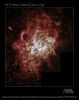
Ultraluminous X-Ray sources in M 74
Da "NASA - Picture of the Day" del 30.03.2005:"In visual appearance, M74 is a nearly perfect face-on spiral galaxy, about 30 million LY away toward the constellation Pisces. The red blotches seen in this composite view are ultraluminous x-ray sources (ULXs) mapped by the Chandra X-ray Observatory. The ULXs are so called because they actually do radiate 10 to 1.000 times more x-ray power than "ordinary" x-ray binary stars, which harbor a neutron star or stellar mass black hole. In fact, watching these ULXs change their x-ray brightness over periods of 2 hours or so, astronomers conclude that ULXs could well be intermediate mass black holes - black holes with masses 10.000 times or so greater than the Sun, but still much less than the million solar mass black holes which lurk in the centers of large spiral galaxies. How did these intermediate mass black holes get there? One intriguing suggestion is that they are left over from the cores of much smaller galaxies that are merging with spiral galaxy M74".
Parole chiave: From Earth Images

Ultraluminous X-Ray sources in M 74

Da "NASA - Picture of the Day" del 30.03.2005:"In visual appearance, M74 is a nearly perfect face-on spiral galaxy, about 30 million LY away toward the constellation Pisces. The red blotches seen in this composite view are ultraluminous x-ray sources (ULXs) mapped by the Chandra X-ray Observatory. The ULXs are so called because they actually do radiate 10 to 1.000 times more x-ray power than "ordinary" x-ray binary stars, which harbor a neutron star or stellar mass black hole. In fact, watching these ULXs change their x-ray brightness over periods of 2 hours or so, astronomers conclude that ULXs could well be intermediate mass black holes - black holes with masses 10.000 times or so greater than the Sun, but still much less than the million solar mass black holes which lurk in the centers of large spiral galaxies. How did these intermediate mass black holes get there? One intriguing suggestion is that they are left over from the cores of much smaller galaxies that are merging with spiral galaxy M74".

M 44 and Saturn.jpg M 51-Supernova.jpg M 74~1.jpg M-033-1.jpg M-045-1.jpg
Informazioni sul file
Nome del file:M 74~1.jpg
Nome album:Deep Sky Objects
Valutazione (12 voti):55555(Mostra dettagli)
Parole chiave:From / Earth / Images
Copyright:X-ray; J. Liu (U.Mich.) et al., CXC, NASA - T. Boroson (NOAO), AURA, NOAO, NSF
Dimensione del file:45 KiB
Data di inserimento:Mar 30, 2005
Dimensioni:576 x 576 pixels
Visualizzato:98 volte
URL:https://www.lunexit.it/gallery/displayimage.php?pid=4981
Preferiti:Aggiungi ai preferiti


Powered by Coppermine Photo Gallery