Inizio Registrati Login

Elenco album Ultimi arrivi Ultimi commenti Più viste Più votate Preferiti Cerca

Inizio > DEEP SKY > Deep Sky Objects
Ritorna alla pagina delle miniature FILE 823/1036 Torna all'inizio Guarda foto precedente Guarda foto successiva Salta alla fine
The language of "Planetary Light"
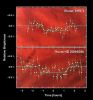
This graph of data from NASA's SST shows changes in the infrared light output of 2 star-planet systems located hundreds of LY away. The data were taken while the planets, called HD 209458b and TrES-1, disappeared behind their stars in what is called a "secondary eclipse." The dip seen in the center of each graph represents the time when the planets were eclipsed, and tells astronomers exactly how much light they emit. 
Why a secondary eclipse? When a planet transits, or passes in front of, its star, it partially blocks the light of the star. When the planet swings around behind the star, the star completely blocks its light. This drop in total light can be measured to determine the amount of light coming from just the planet. 
Why infrared? In visible light, the glare of a star overwhelms its planetary companion and the little light the planet reflects. In infrared, a star shines less brightly and its planet gives off its own internal light, or heat radiation, making the planet easier to detect. By observing these secondary eclipses at different infrared wavelengths, astronomers can obtain the planet's temperature, and, in the future, they may be able to pick out chemicals sprinkled throughout a planet's atmosphere. The technique also reveals whether a planet's orbit is elongated or circular".
Parole chiave: Graphs and Spectra

The language of "Planetary Light"

This graph of data from NASA's SST shows changes in the infrared light output of 2 star-planet systems located hundreds of LY away. The data were taken while the planets, called HD 209458b and TrES-1, disappeared behind their stars in what is called a "secondary eclipse." The dip seen in the center of each graph represents the time when the planets were eclipsed, and tells astronomers exactly how much light they emit.
Why a secondary eclipse? When a planet transits, or passes in front of, its star, it partially blocks the light of the star. When the planet swings around behind the star, the star completely blocks its light. This drop in total light can be measured to determine the amount of light coming from just the planet.
Why infrared? In visible light, the glare of a star overwhelms its planetary companion and the little light the planet reflects. In infrared, a star shines less brightly and its planet gives off its own internal light, or heat radiation, making the planet easier to detect. By observing these secondary eclipses at different infrared wavelengths, astronomers can obtain the planet's temperature, and, in the future, they may be able to pick out chemicals sprinkled throughout a planet's atmosphere. The technique also reveals whether a planet's orbit is elongated or circular".

Planetary_Nebulae.jpg Planets in my mind-274.jpg PlanetsLight-PIA07491.jpg Polaris.jpg Procyon.jpg
Informazioni sul file
Nome del file:PlanetsLight-PIA07491.jpg
Nome album:Deep Sky Objects
Valutazione (5 voti):55555(Mostra dettagli)
Parole chiave:Graphs / and / Spectra
Copyright:NASA/JPL-Caltech/Harvard-Smithsonian CfA/GSFC
Dimensione del file:45 KiB
Data di inserimento:Mar 29, 2005
Dimensioni:558 x 597 pixels
Visualizzato:56 volte
URL:https://www.lunexit.it/gallery/displayimage.php?pid=4966
Preferiti:Aggiungi ai preferiti


Powered by Coppermine Photo Gallery