|
|
Looking back...
|
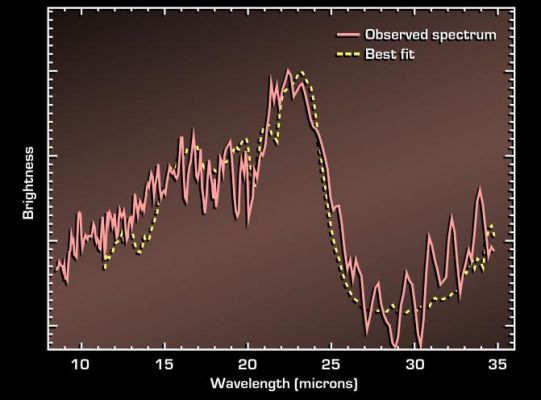
This graph, or spectrum, shows the light from a dusty, distant galaxy (invisible to optical telescopes) that is located 11 BLY away. NASA's SST was able to capture the light from it by using heat-seeking infrared eyes. Spectra are created when a spectrograph spreads light out into its basic parts, like a prism turning sunlight into a rainbow. The spectra contain the signatures of molecules that contribute to an object's light. In this case, the galaxy's spectrum reveals the fingerprint for silicate dust (large dip at right), a planetary building block like sand, only smaller. This particular fingerprint is important because it helps to determine how far away the galaxy lies as well as how much the galaxy's light had stretched ("redshifted") during its journey to SST's eyes. Because the universe is expanding, a galaxy's light will shift toward reddish wavelengths as it moves away from us. This galaxy has a redshift of 1,95, meaning that its light travelled for 11 BY before 'hitting" SST's eyes. The presence of the silicate fingerprint is also significant because it implies that galaxies were ripe for planetary formation 11 billion years ago - back to a time when the universe was 3 billion years old. The universe is currently believed to be 13.5 billion years old. This is the furthest back in time that silicate dust has been detected around a galaxy.
|
|