|
|
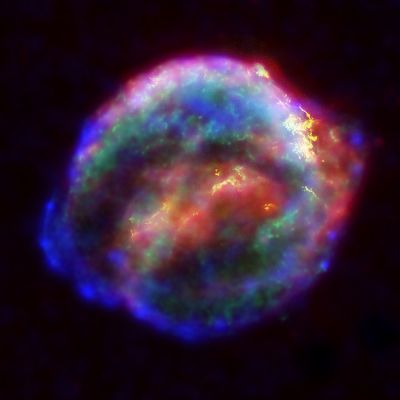
Supernova remnant SNR-1604
|
Light from the stellar explosion that created this energized cosmic cloud was first seen on planet Earth in October 1604. The supernova produced a bright new star in early 17th century skies within the constellation Ophiucus and it was studied by the Great astronomer Johannes Kepler and his contemporaries, without the benefit of a telescope! Armed with a modern understanding of stellar evolution, early 21st century astronomers continue to explore the expanding debris cloud, but can now use orbiting space telescopes to survey Kepler's supernova remnant (SNR) across the spectrum. In this tantalizing composite image, x-rays, visible light, and infrared radiation recorded by NASA's astrophysical observatories - Chandra X-Ray Observatory, HST and SST - are combined to give a more comprehensive view of the still enigmatic supernova remnant. About 13.000 LY away, SNR 1604 represents the most recent stellar explosion seen to occur within our Galaxy.
|
|