Inizio Registrati Login

Elenco album Ultimi arrivi Ultimi commenti Più viste Più votate Preferiti Cerca

Inizio > MARS > Curiosity and the Exploration of Gale Crater
Ritorna alla pagina delle miniature FILE 69/259 Torna all'inizio Guarda foto precedente Guarda foto successiva Salta alla fine
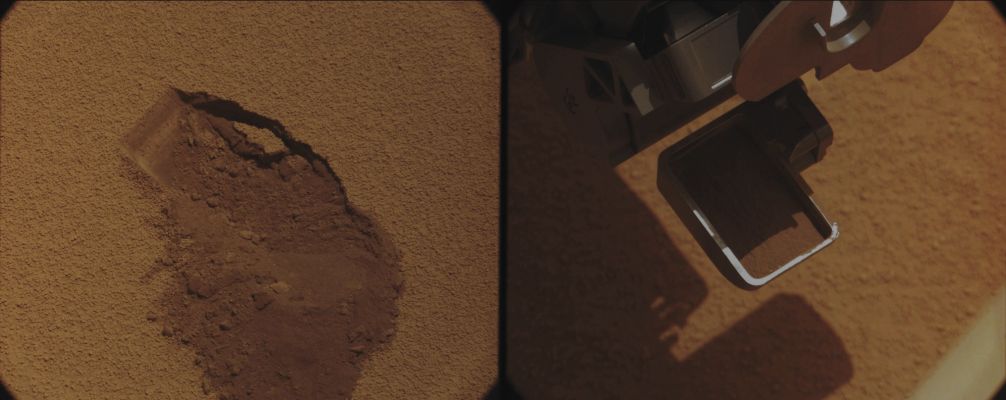
First "Scoop" at Gale - Sol 61 (Absolute Natural Colors; credits for the additional process. and color.: Dr Paolo C. Fienga/Lunar Explorer Italia/Italian Planetary Foundation)
Caption NASA:"This pairing illustrates the first time that the NASA's Mars Exploration Rover Curiosity collected a scoop of Soil on Mars. It combines two raw images taken on the mission's 61st Martian Day, or Sol (such as October, 7, 2012) by the right camera of the Rover's two-camera Mast Camera (Mastcam) instrument. The right Mastcam, or Mastcam-100, has a telephoto, 100-millimeter-focal-length lens.
The image on the left shows the Ground at the location "Rocknest" after the scoop of Sand and Dust had been removed. The image on the right shows the Sandy and Dusty Material inside the Rover's Scoop, which is 1,8" (inches - such as approx. 4,5 centimeters) wide, and 2.8" (about 7 centimeters) long".
Parole chiave: Martian Surface - Gale Crater - Disturbed Terrain - Proximities of the Landing Site

First "Scoop" at Gale - Sol 61 (Absolute Natural Colors; credits for the additional process. and color.: Dr Paolo C. Fienga/Lunar Explorer Italia/Italian Planetary Foundation)

Caption NASA:"This pairing illustrates the first time that the NASA's Mars Exploration Rover Curiosity collected a scoop of Soil on Mars. It combines two raw images taken on the mission's 61st Martian Day, or Sol (such as October, 7, 2012) by the right camera of the Rover's two-camera Mast Camera (Mastcam) instrument. The right Mastcam, or Mastcam-100, has a telephoto, 100-millimeter-focal-length lens.
The image on the left shows the Ground at the location "Rocknest" after the scoop of Sand and Dust had been removed. The image on the right shows the Sandy and Dusty Material inside the Rover's Scoop, which is 1,8" (inches - such as approx. 4,5 centimeters) wide, and 2.8" (about 7 centimeters) long".

SOL0061-2ML0283001000E1_DXXX-GB-LXTT-IPF.jpg SOL0061-ML0315000082M0_DXXX-0061ML0315000239M0_DXXX-GB-LXTT-IPF.gif SOL0061-PIA16226-PCF-LXTT-IPF.jpg SOL0062-EB-MF-LXTT-IPF.jpg SOL0063-PIA16194-PCF-LXTT-IPF.jpg
Informazioni sul file
Nome del file:SOL0061-PIA16226-PCF-LXTT-IPF.jpg
Nome album:MareKromium / Curiosity and the Exploration of Gale Crater
Valutazione (5 voti):55555(Mostra dettagli)
Parole chiave:Martian / Surface / - / Gale / Crater / - / Disturbed / Terrain / - / Proximities / of / the / Landing / Site
Copyright:NASA/JPL-Caltech/MSSS and Dr Paolo C. Fienga/Lunar Explorer Italia/IPF per l'additional process. e la colorizzazione
Dimensione del file:440 KiB
Data di inserimento:Ott 15, 2012
Dimensioni:3000 x 1192 pixels
Visualizzato:121 volte
URL:https://www.lunexit.it/gallery/displayimage.php?pid=30851
Preferiti:Aggiungi ai preferiti

Commento 1 a 11 di 11
Pagina: 1

paolocf1963   [Nov 22, 2012 at 06:54 AM]
LA CANADA FLINTRIDGE - The Curiosity rover's lead scientist hinted at potentially significant findings from Mars in an NPR report Tuesday, setting off a storm of speculation, but JPL has since tried to temper expectations.
"This data is gonna be one for the history books. It's looking really good," Curiosity project scientist John Grotzinger of Caltech said in the report. Grotzinger was describing initial results from the rover's Sample Analysis at Mars - or SAM - suite of instruments, but offered no other details because scientists had yet to confirm the findings.
Curiosity's holy grail is organic compounds, such as methane gas, which would provide a major clue that life might have once existed on Mars.
That's what SAM tests for, fueling speculation about Curiosity's discovery. Organic compounds contain carbon, the element that's considered the basic building block of life.
However, JPL spokesman pointed out Wednesday that the reported "earthshaking" news wasn't Grotzinger's description. Curiosity's official Twitter account also struck a less dramatic chord on Wednesday: "What did I discover on Mars? That rumors spread fast online. My team considers this whole mission `one for the history books."'

JPL said the findings will be revealed Dec. 3 at the American Geophysical Union conference in San Francisco. Curiosity is no stranger to what could be described as big news.

Since its celebrated landing in Mars' Gale Crater in August for a two-year mission, the rover has already found that an ancient streambed once rushed through the area, and found that properly equipped astronauts could withstand the planet's radiation.
The soil sample it collected for its first SAM test wasn't expected to come up with organic compounds, however.
The sample came from Rocknest, a sandy, windblown spot where previous tests had already shown much of the material had been transported from elsewhere.
"We received good data from this first solid sample," SAM principal investigator Paul Mahaffy said in a Nov. 13 status report.
The rover's ultimate destination is Mt. Sharp, in the center of the crater, where layered rock provides a good chance to find organics. SAM has three instruments that test for chemistry relevant to life: a mass spectrometer, a tunable laser spectrometer and a gas chromatograph.
They can identify and measure gases, and provide plenty of ways for scientists to make findings important to the scientific community. The laser spectrometer is capable of measuring isotopes, which could help determine how Mars lost much of its atmosphere, according to the Curiosity press kit.
JPL and Grotzinger's cautiousness has already prevented a mistaken announcement once during the Curiosity mission, when a methane finding wasn't supported by subsequent tests, according to NPR.
MareKromium   [Nov 22, 2012 at 07:11 AM]
Mia opinione. Delle due, l'una: o è la solita "notizia-bolla-di-sapone" (non mi sorprenderebbe affatto), oppure potrebbero aver riscontrato tracce di Vita attuale. Trovare tracce di Vita batterica pregressa su Marte, a mio umilissimo parere e viste le nostre conoscenze, non sarebbe affatto una Scoperta Epocale. - paolo
Anakin   [Nov 22, 2012 at 07:39 AM]
Credo una via di mezzo. Qualche batterio ultramicroscopico ancora in vita che fa le puzzette. Alla faccia della scoperta epocale, se fosse così
paolocf1963   [Nov 22, 2012 at 08:08 AM]
Incredibile: ma lo sai che è ESATTAMENTE la STESSA IMMAGINE che mi è venuta in mente? Un microbatterio scorreggione che rilascia metano a gò-gò!!! E' proprio vero: i simili con i simili. Un Abbraccio Circolare - paolo
Anakin   [Nov 22, 2012 at 10:24 AM]
L'Universo sarà pieno di questi batteri scoreggioni
2di7   [Nov 22, 2012 at 11:41 AM]
Ciao doc! Vedo che l'hai trovata! Personalmente ho qualche dubbio che sia la notizia che tutti si aspettano...
paolocf1963   [Nov 22, 2012 at 02:29 PM]
Ciao Eli! Personalmente, io ho qualche dubbio. E mi fermo qui... :-)
Omomoto   [Nov 22, 2012 at 06:12 PM]
Se hanno trovato il flautulobacillus martiensis, john grotzinger verrà promosso e messo a scrivere 1000 volte su una lavagna "non si cambiano i libri di storia". Poi verrà incolpato un addetto alle pulizie di aver scoreggiato nei locali dove assemblavano Curiosity o qualche informatico di aver inserito libre invece di grammi nel software del SAM
paolocf1963   [Nov 22, 2012 at 07:58 PM]
Ahahahahahahahahha!!!1 Mi hai fatto rasserenare Grande Omomoto!!! Abbraccio! paolo
Anakin   [Nov 28, 2012 at 10:32 AM]
INZIATO il TAM TAM mediatico in rete tra le varie testate che "annunciano" la nuova notizia prevista per il 3 dicembre e che molto probabilmente riguarderà la scoperta di molecole organiche...
pierluigi   [Nov 28, 2012 at 03:06 PM]
Ma alle stesse conclusioni, senza entrare nei libri di storia, non era arrivato il Viking ?

Commento 1 a 11 di 11
Pagina: 1


Powered by Coppermine Photo Gallery