|
|
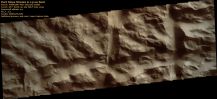
Lycus Sulci in broad Daylight (Absolute Natural Colors; credits for the additional process. and color.: Elisabetta Bonora and Marco Faccin/LXTT/IPF)
|
In this VIS image, taken by the NASA - Mars Odyssey Orbiter on February, 26th, 2014, and during its 54.147th orbit around the Red Planet, we can see a very small (but well illuminated) portion of the Martian Region known as Lycus Sulci: a Complex Region - mostly covered by Ridges - thst is located on the Northern Side of the largest and tallest Mountain of the Solar System: the Shield-Volcano known as Olympus Mons.
On the illuminated Slopes of the Ridges, a number of Dark Striations (perhaps Seeps, or maybe simple Dust-Slides) can be easily spotted and, furthermore, if you look carefully at the picture, you will also be able to see, in between the Ridges themselves, a complex network of tiny Sand Ripples, Out of curiosiity, the term "Sulci" (from the Latin word "Sulcus") means a System of Sub-Parallel Furrows (---> long and narrow Trenches) and Ridges.
Latitude (centered): 31,6354° North
Longitude (centered): 220,3990° East
Instrument: VIS
This image (which is a crop taken from an Original Mars Odyssey Orbiter b/w and Map-Projected frame published on the NASA - Planetary Photojournal with the ID n. PIA 18236) has been additionally processed, magnified to aid the visibility of the details, contrast enhanced and sharpened, Gamma corrected and then colorized in Absolute Natural Colors (such as the colors that a human eye would actually perceive if someone were onboard the NASA - Mars Odyssey Orbiter and then looked down, towards the Surface of Mars), by using an original technique created - and, in time, dramatically improved - by the Lunar Explorer Italia Team.
|
|