Inizio Registrati Login

Elenco album Ultimi arrivi Ultimi commenti Più viste Più votate Preferiti Cerca

Inizio > SOLAR SYSTEM > Titan: The "Foggy" Moon
Ritorna alla pagina delle miniature FILE 91/426 Torna all'inizio Guarda foto precedente Guarda foto successiva Salta alla fine
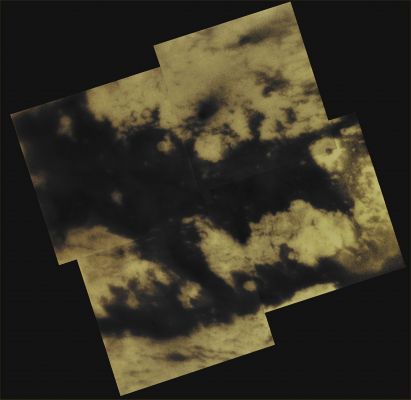
Fensal and Aztlan (CTX Image-Mosaic - Absolute Natural Colors; credits for the additional process. and color.: Dr Paolo C. Fienga/Lunar Explorer Italia/Italian Planetary Foundation)
During its September 7, 2005, Fly-By of the Saturnian moon Titan, the NASA - Cassini Spacecraft acquired a series of images of a Territory located on the moon's Saturn-facing Hemisphere that were afterwards assembled so to create this small mosaic: once known only as "The H" (because this whole Region looks something like the letter "H", when oriented on its side), the Surface Features visible here now possess provisional names that were assigned to them by the International Astronomical Union (or "IAU", for short). 
The Northern Branch of "The H" is now called "Fensal," while the Southern Branch is known as "Aztlan."
Fensal is littered with small "Island-like Landforms" ranging in size from about 5 to 40 Km (such as from approx. 3,1 to a little less than 25 miles) across. These Landforms currently are thought to be Water-Ice Upland Areas (---> kind of small Hills), surrounded by shallower Terrain that is filled-in with dark Particulate Material probably precipitated from the Lower Atmosphere of Titan. In Western Fensal, a few larger Islands can also be seen, like Bazaruto Facula (visible to the right here and containing what seems to be an Impact Crater or, maybe, a Volcanic Edifice). When viewed in images of Shangri-La (another Titanian Region located on the opposite side of Titan as to Fensal and Aztlan), the Island-like Landforms of this size tend to occur in "clusters" (---> groups) with an apparent so-called "Preferred Orientation" (perhaps due to the action of the Dominant Winds blowing over those Territories). The small Islands found in Fensal, instead, appear much more scattered (and most of them appear roughly circular), although a few Islands do have (show) an East-West orientation to their long axis.
Aztlan, on the other hand, appears comparatively devoid of small Island-like Landforms, with only three large Islands located in its Western Reaches, plus only a few smaller Islands. The largest one of these Landforms is called "Sotra Facula" (visible just right of center in the bottom left portion of the mosaic), and measures approx. 240 by 120 Km (such as about 149 to 74,52 miles) across.

The mosaic is centered at 7° North Latitude and 21° West Longitude on Titan and the frames composing it were taken by the NASA - Cassini Spacecraft Narrow-Angle Camera using a filter sensitive to Wavelengths of Near-InfrarRed Light centered at 938 nanometers. They were acquired at distances ranging from approximately 200.600 to 191.800 Km (such as from about 124.572 to 119.108 miles) from Titan. The Mean Resolution in the images forming the mosaic is about 2 Km (such as 1,242 miles) per pixel.

This picture (which is an Original NASA - Cassini Spacecraft b/w image-mosaic published on the NASA - Planetary Photojournal and identified by the n. PIA 07732) has been additionally processed, magnified, contrast enhanced and then colorized, according to an educated guess carried out by Dr Paolo C. Fienga (LXTT-IPF), in Absolute Natural Colors (such as the colors that a human eye would actually perceive if someone were onboard the NASA - Cassini Spacecraft and then looked outside, towards the Saturnian moon Titan), by using an original technique created - and, in time, dramatically improved - by the Lunar Explorer Italia Team. Different colors, as well as different shades of the same color, mean, among others, the existence of different Elements present in the Atmosphere and on the Surface of Titan, each having a different Albedo (---> Reflectivity) and Chemical Composition. 

Note: it is possible (but we, as IPF, have no way to be one-hundred-percent sure of such a circumstance), that the actual luminosity of the Clouds and Hazes (as well as the luminosity of the Surface of Titan itself), as seen in this mosaic, would appear, to an average human eye, way lower than it has been shown (or, better yet: interpreted) here.
Parole chiave: Titan

Fensal and Aztlan (CTX Image-Mosaic - Absolute Natural Colors; credits for the additional process. and color.: Dr Paolo C. Fienga/Lunar Explorer Italia/Italian Planetary Foundation)

During its September 7, 2005, Fly-By of the Saturnian moon Titan, the NASA - Cassini Spacecraft acquired a series of images of a Territory located on the moon's Saturn-facing Hemisphere that were afterwards assembled so to create this small mosaic: once known only as "The H" (because this whole Region looks something like the letter "H", when oriented on its side), the Surface Features visible here now possess provisional names that were assigned to them by the International Astronomical Union (or "IAU", for short).
The Northern Branch of "The H" is now called "Fensal," while the Southern Branch is known as "Aztlan."
Fensal is littered with small "Island-like Landforms" ranging in size from about 5 to 40 Km (such as from approx. 3,1 to a little less than 25 miles) across. These Landforms currently are thought to be Water-Ice Upland Areas (---> kind of small Hills), surrounded by shallower Terrain that is filled-in with dark Particulate Material probably precipitated from the Lower Atmosphere of Titan. In Western Fensal, a few larger Islands can also be seen, like Bazaruto Facula (visible to the right here and containing what seems to be an Impact Crater or, maybe, a Volcanic Edifice). When viewed in images of Shangri-La (another Titanian Region located on the opposite side of Titan as to Fensal and Aztlan), the Island-like Landforms of this size tend to occur in "clusters" (---> groups) with an apparent so-called "Preferred Orientation" (perhaps due to the action of the Dominant Winds blowing over those Territories). The small Islands found in Fensal, instead, appear much more scattered (and most of them appear roughly circular), although a few Islands do have (show) an East-West orientation to their long axis.
Aztlan, on the other hand, appears comparatively devoid of small Island-like Landforms, with only three large Islands located in its Western Reaches, plus only a few smaller Islands. The largest one of these Landforms is called "Sotra Facula" (visible just right of center in the bottom left portion of the mosaic), and measures approx. 240 by 120 Km (such as about 149 to 74,52 miles) across.

The mosaic is centered at 7° North Latitude and 21° West Longitude on Titan and the frames composing it were taken by the NASA - Cassini Spacecraft Narrow-Angle Camera using a filter sensitive to Wavelengths of Near-InfrarRed Light centered at 938 nanometers. They were acquired at distances ranging from approximately 200.600 to 191.800 Km (such as from about 124.572 to 119.108 miles) from Titan. The Mean Resolution in the images forming the mosaic is about 2 Km (such as 1,242 miles) per pixel.

This picture (which is an Original NASA - Cassini Spacecraft b/w image-mosaic published on the NASA - Planetary Photojournal and identified by the n. PIA 07732) has been additionally processed, magnified, contrast enhanced and then colorized, according to an educated guess carried out by Dr Paolo C. Fienga (LXTT-IPF), in Absolute Natural Colors (such as the colors that a human eye would actually perceive if someone were onboard the NASA - Cassini Spacecraft and then looked outside, towards the Saturnian moon Titan), by using an original technique created - and, in time, dramatically improved - by the Lunar Explorer Italia Team. Different colors, as well as different shades of the same color, mean, among others, the existence of different Elements present in the Atmosphere and on the Surface of Titan, each having a different Albedo (---> Reflectivity) and Chemical Composition.

Note: it is possible (but we, as IPF, have no way to be one-hundred-percent sure of such a circumstance), that the actual luminosity of the Clouds and Hazes (as well as the luminosity of the Surface of Titan itself), as seen in this mosaic, would appear, to an average human eye, way lower than it has been shown (or, better yet: interpreted) here.

Titan-EB.gif Titan-EB.jpg Titan-Fensal_and_Aztlan-PIA07732-PCF-LXTT-IPF-0.jpg Titan-Fensal_and_Aztlan-PIA07732-PCF-LXTT-IPF-1.jpg Titan-Full_Disk-PIA02145-1.jpg
Informazioni sul file
Nome del file:Titan-Fensal_and_Aztlan-PIA07732-PCF-LXTT-IPF-0.jpg
Nome album:MareKromium / Titan: The "Foggy" Moon
Valutazione (2 voti):55555(Mostra dettagli)
Parole chiave:Titan
Copyright:NASA/JPL/Space Science Institute and Dr Paolo C. Fienga - Lunar Explorer Italia per l'additional process. e la colorizzazione del frame
Dimensione del file:558 KiB
Data di inserimento:Giu 16, 2013
Dimensioni:2990 x 2905 pixels
Visualizzato:59 volte
URL:https://www.lunexit.it/gallery/displayimage.php?pid=31120
Preferiti:Aggiungi ai preferiti


Powered by Coppermine Photo Gallery