Inizio Registrati Login

Elenco album Ultimi arrivi Ultimi commenti Più viste Più votate Preferiti Cerca

Inizio > SOLAR SYSTEM > Titan: The "Foggy" Moon
Ritorna alla pagina delle miniature FILE 54/426 Torna all'inizio Guarda foto precedente Guarda foto successiva Salta alla fine
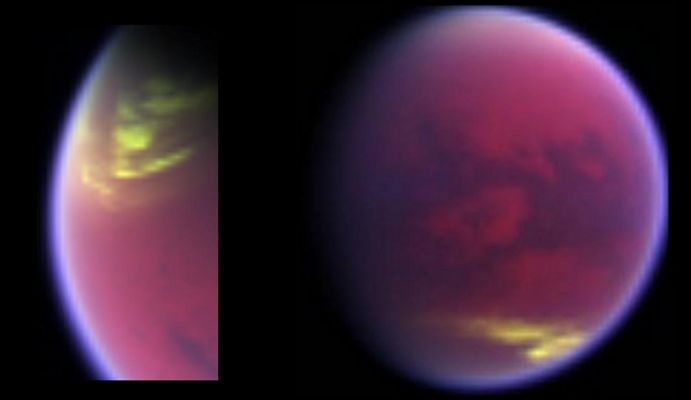
Titanian Clouds (False Colors; credits: NASA/JPL/University of Arizona/University of Nantes/University of Paris Diderot)
Caption NASA:"This pair of false-color images, made from data obtained by NASA's Cassini Spacecraft, shows clouds covering parts of Saturn's moon Titan in yellow. Based on the way Near-InfraRed channels of light were color-coded, cloud cover appears yellow, while Titan's hazy Atmosphere appears magenta. The images show cloud cover dissolving from Titan's North Polar Region between May 12, 2008 (left), and Dec. 12, 2009 (right). The clouds in the second image appear around 40° South Latitude, still active late after Titan's Equinox. 
Cassini's first observations of clouds near this Latitude occurred during Summer in the Southern Hemisphere. Equinox, when the Sun shone directly over the Equator, occurred in August 2009. It brought a changing of the seasons, as Titan moved out of Southern Summer into Northern Spring. 

For the past 6 years, Cassini has observed clouds clustered in three distinct Latitude Regions of Titan: large clouds at the North Pole, patchy cloud at the South Pole and a narrow belt around 40° South. Now scientists are seeing evidence of seasonal circulation turnover at Titan. Clouds at the South Pole disappeared just before Equinox and the clouds in the North are thinning out. This activity agrees with models that predict cloud activity reversing from one Hemisphere to another.

During Winter in the Northern Hemisphere, Northern Polar Clouds of Ethane formed in Titan's Troposphere, the lowest part of the Atmosphere, from a constant influx of Ethane and Aerosols from a higher part of the Atmosphere known as the Stratosphere. 
In the Southern Hemisphere, atmospheric gases enriched with Methane welled up from the Surface to produce Mid and High-Latitude Clouds.

The data for the images was detected by Cassini's Visual and InfraRed Mapping Spectrometer in Near-IR wavelengths. Scientists focused on three wavelengths of IR radiation that were particularly good for observing cloud signatures and assigned them red, green and blue channels. 

Emissions in the 2 micron wavelength of light, colored red, detect the Titan Surface. 
Emissions in the 2,11 micron wavelength, colored green, detect the lowest part of the Titan Atmosphere, or Troposphere. 
Emissions at the 2,21 micron wavelength, colored blue, detect the hazy Stratosphere, a higher part of the Atmosphere. 

The clouds appear yellowish because they lit up the channels designated red and green, but not the blue channel".
Parole chiave: Titan

Titanian Clouds (False Colors; credits: NASA/JPL/University of Arizona/University of Nantes/University of Paris Diderot)

Caption NASA:"This pair of false-color images, made from data obtained by NASA's Cassini Spacecraft, shows clouds covering parts of Saturn's moon Titan in yellow. Based on the way Near-InfraRed channels of light were color-coded, cloud cover appears yellow, while Titan's hazy Atmosphere appears magenta. The images show cloud cover dissolving from Titan's North Polar Region between May 12, 2008 (left), and Dec. 12, 2009 (right). The clouds in the second image appear around 40° South Latitude, still active late after Titan's Equinox.
Cassini's first observations of clouds near this Latitude occurred during Summer in the Southern Hemisphere. Equinox, when the Sun shone directly over the Equator, occurred in August 2009. It brought a changing of the seasons, as Titan moved out of Southern Summer into Northern Spring.

For the past 6 years, Cassini has observed clouds clustered in three distinct Latitude Regions of Titan: large clouds at the North Pole, patchy cloud at the South Pole and a narrow belt around 40° South. Now scientists are seeing evidence of seasonal circulation turnover at Titan. Clouds at the South Pole disappeared just before Equinox and the clouds in the North are thinning out. This activity agrees with models that predict cloud activity reversing from one Hemisphere to another.

During Winter in the Northern Hemisphere, Northern Polar Clouds of Ethane formed in Titan's Troposphere, the lowest part of the Atmosphere, from a constant influx of Ethane and Aerosols from a higher part of the Atmosphere known as the Stratosphere.
In the Southern Hemisphere, atmospheric gases enriched with Methane welled up from the Surface to produce Mid and High-Latitude Clouds.

The data for the images was detected by Cassini's Visual and InfraRed Mapping Spectrometer in Near-IR wavelengths. Scientists focused on three wavelengths of IR radiation that were particularly good for observing cloud signatures and assigned them red, green and blue channels.

Emissions in the 2 micron wavelength of light, colored red, detect the Titan Surface.
Emissions in the 2,11 micron wavelength, colored green, detect the lowest part of the Titan Atmosphere, or Troposphere.
Emissions at the 2,21 micron wavelength, colored blue, detect the hazy Stratosphere, a higher part of the Atmosphere.

The clouds appear yellowish because they lit up the channels designated red and green, but not the blue channel".

Titan-Clouds-PIA12813.jpg Titan-Clouds-PIA13400-PCF-LXTT.jpg Titan-Clouds-PIA13400.jpg Titan-Clouds-Rain_Clouds-PIA12818-00.jpg Titan-Clouds-Rain_Clouds-PIA12818-01.jpg
Informazioni sul file
Nome del file:Titan-Clouds-PIA13400.jpg
Nome album:MareKromium / Titan: The "Foggy" Moon
Valutazione (1 voti):55555(Mostra dettagli)
Parole chiave:Titan
Copyright:NASA/JPL/University of Arizona/University of Nantes/University of Paris Diderot
Dimensione del file:45 KiB
Data di inserimento:Set 24, 2010
Dimensioni:1500 x 868 pixels
Visualizzato:92 volte
URL:https://www.lunexit.it/gallery/displayimage.php?pid=27547
Preferiti:Aggiungi ai preferiti


Powered by Coppermine Photo Gallery