Inizio Registrati Login

Elenco album Ultimi arrivi Ultimi commenti Più viste Più votate Preferiti Cerca

Inizio > MARS > From Ashes to Eternity: the Phoenix Mars Mission
Ritorna alla pagina delle miniature FILE 24/403 Torna all'inizio Guarda foto precedente Guarda foto successiva Salta alla fine
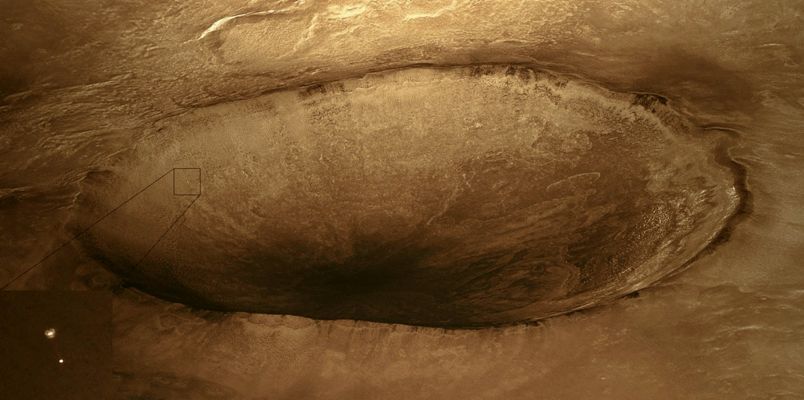
The Descent of Phoenix, from MRO - Sol 0 (MULTISPECTRUM; credits: Lunexit)
Caption NASA:"MRO's HiRISE camera acquired this dramatic oblique image of Phoenix descending on its parachute. Shown here is a a wider view of the full image, showing a 10 Km diameter crater informally called “Heimdall,” and an improved full-resolution image of the parachute and lander (in the inset). 

Although it appears that Phoenix is descending into the crater, it is actually about 20 Km in front of it. It is difficult to believe that it is in front of the crater because it is so much smaller, but in reality it is, and that's a good thing because landing on the steep rocky slopes of the crater would have been far too exciting (or risky). 

Images from the lander clearly show that it sits on a flat plain, although the rim of Heimdall may be visible on the horizon. Given the position and pointing angle of MRO, Phoenix is at about 13 Km above the surface, just a few seconds after the parachute opened. 
This improved image shows some details of the parachute, including the gap between upper and lower sections. At the time of this observation, MRO had an orbital altitude of 310 Km, traveling at a ground velocity of 3,4 Km/second, and a distance of 760 Km to the Phoenix lander. 

The image was rotated to a position that seems approximately parallel to the horizon based on the elongation of Heimdall Crater, but this is not exact. Thus, although Phoenix appears to hang from the parachute at an angle, as if swaying in the wind, the exact geometry has not yet been determined. The parachute image is very sharp as its apparent motion was straight down the HiRISE TDI (Time Delay Integration) columns. However, the surface of Mars was moving at an angle to the TDI columns, and thus is smeared by a few pixels, although the smear is not apparent at the reduced scale of the image shown here. 

The Sun is almost directly behind HiRISE, so the parachute should be casting a shadow onto the slope of the Crater, but we cannot determine which of many dark spots is the shadow until a detailed geometric analysis has been completed". 
Parole chiave: Mars from orbit - Craters - Heimdall Crater and Phoenix

The Descent of Phoenix, from MRO - Sol 0 (MULTISPECTRUM; credits: Lunexit)

Caption NASA:"MRO's HiRISE camera acquired this dramatic oblique image of Phoenix descending on its parachute. Shown here is a a wider view of the full image, showing a 10 Km diameter crater informally called “Heimdall,” and an improved full-resolution image of the parachute and lander (in the inset).

Although it appears that Phoenix is descending into the crater, it is actually about 20 Km in front of it. It is difficult to believe that it is in front of the crater because it is so much smaller, but in reality it is, and that's a good thing because landing on the steep rocky slopes of the crater would have been far too exciting (or risky).

Images from the lander clearly show that it sits on a flat plain, although the rim of Heimdall may be visible on the horizon. Given the position and pointing angle of MRO, Phoenix is at about 13 Km above the surface, just a few seconds after the parachute opened.
This improved image shows some details of the parachute, including the gap between upper and lower sections. At the time of this observation, MRO had an orbital altitude of 310 Km, traveling at a ground velocity of 3,4 Km/second, and a distance of 760 Km to the Phoenix lander.

The image was rotated to a position that seems approximately parallel to the horizon based on the elongation of Heimdall Crater, but this is not exact. Thus, although Phoenix appears to hang from the parachute at an angle, as if swaying in the wind, the exact geometry has not yet been determined. The parachute image is very sharp as its apparent motion was straight down the HiRISE TDI (Time Delay Integration) columns. However, the surface of Mars was moving at an angle to the TDI columns, and thus is smeared by a few pixels, although the smear is not apparent at the reduced scale of the image shown here.

The Sun is almost directly behind HiRISE, so the parachute should be casting a shadow onto the slope of the Crater, but we cannot determine which of many dark spots is the shadow until a detailed geometric analysis has been completed".

E-PIA10633.jpg PHOE-SOL000-HIRISE.jpg PHOE-SOL000-PSP_008579_9020.jpg PHOE-SOL001-M-Photocomposite-00.jpg PHOE-SOL001-M-Photocomposite-01.jpg
Informazioni sul file
Nome del file:PHOE-SOL000-PSP_008579_9020.jpg
Nome album:MareKromium / From Ashes to Eternity: the Phoenix Mars Mission
Valutazione (4 voti):55555(Mostra dettagli)
Parole chiave:Mars / from / orbit / - / Craters / - / Heimdall / Crater / and / Phoenix
Copyright:NASA/JPL/University of Arizona e Lunar Explorer Italia per l'ingrandimento, l'elaborazione addizionale e la colorizzazione del frame
Dimensione del file:310 KiB
Data di inserimento:Mag 28, 2008
Dimensioni:1991 x 990 pixels
Visualizzato:53 volte
URL:https://www.lunexit.it/gallery/displayimage.php?pid=20543
Preferiti:Aggiungi ai preferiti

Commento 1 a 3 di 3
Pagina: 1

MareKromium   [Feb 24, 2021 at 03:48 PM]
Eccolo il dj vu!!!
walthari   [Feb 24, 2021 at 04:11 PM]
no comment
MareKromium   [Feb 24, 2021 at 06:08 PM]
...e che vuoi aggiungere se non un "no comment"?!? Mi sembra tutto gi visto. Ma la Verit che Noi guardiamo, ricordiamo e quindi riconosciamo. E gli "altri"?!? Tristezza. :-(

Commento 1 a 3 di 3
Pagina: 1


Powered by Coppermine Photo Gallery