Inizio Registrati Login

Elenco album Ultimi arrivi Ultimi commenti Più viste Più votate Preferiti Cerca

Inizio > MARS > After One-Thousand Soles...
Ritorna alla pagina delle miniature FILE 1547/2388 Torna all'inizio Guarda foto precedente Guarda foto successiva Salta alla fine
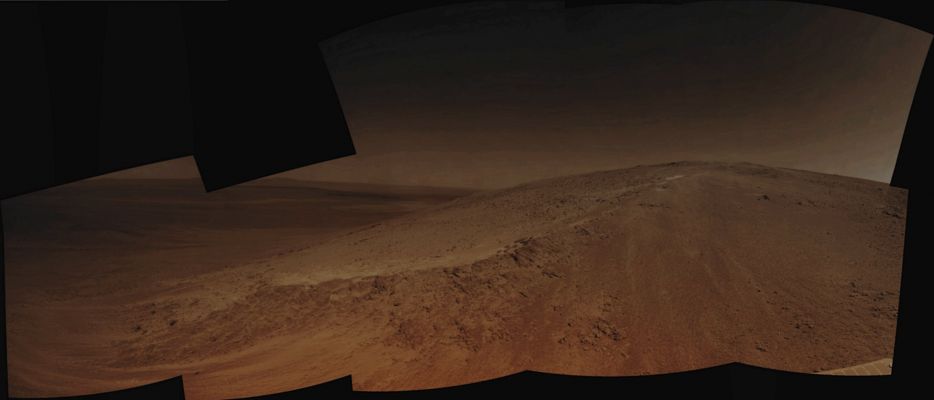
On the Outer Rim of Endeavour Crater (Image-Mosaic - Absolute Natural Colors; credits for the additional process. and color. Dr Paolo C. Fienga/Lunar Explorer Italia/Italian Planetary Foundation)
This is an image-mosaic that shows us the lower reaches of an area of Meridiani Planum (please, remember that we are now very close to the Outer Rim of the large Endeavour Crater) that is informally known as "Murray Ridge". The individual images that were used to create this mosaic were all acquired during the 3466th Sol (such as October, 24, 2013 on Earth) of exploration of the Martian peri-Equatorial Region of Meridiani Planum, by using the Navigation Camera (or "NavCam", for short) that is onboard the NASA - Mars Exploration Rover (MER) - "Opportunity".
This Ridge, as we mentioned herebefore, is part of the Outer Rim of Endeavour Crater and it has been identified by the Opportunity's Science Team as an important Site for scientific exploration. The Ridge has been (so far) informally named "Murray Ridge" to honor the late Dr Bruce Murray, who made fundamental advances in Mars Science and who led the NASA's Jet Propulsion Laboratory through a period of great challenges and achievements. 

This frame (which is an Original NASA - Mars Exploration Rover (MER) - "Opportunity" Original b/w image published on the NASA - Planetary Photojournal and identified by the ID n. PIA 17585) has been additionally processed (where the additional processing has been based on the assumption that the Atmospheric Opacity - "TAU" - of the pictured area was LOW), Gamma corrected and then colorized in Absolute Natural Colors (such as the colors that a normal - meaning "in the average" - human eye would actually perceive if someone were on the Surface of Mars, near the NASA - Mars Exploration Rover (MER) - Opportunity, and then looked ahead, towards the Surface, Horizon and Sky over Endeavour Crater), by using an original technique created - and, in time, dramatically improved - by the Lunar Explorer Italia Team. 

Note: please consider that the Martian Sky (as it has been colored and represented in this picture) appears extremely dark because quite a few of the frames used to make the mosaic were taken during the hours of the Martian Middle/Late Afternoon, such as during that period of the day when the luminosity of the Martian Sky itself (better yetç: that porton of it which is not near, around and/or right above the Sun's disk) drops rapidly and dramatically.
Parole chiave: Martian Surface - Craters - Endeavour Crater - Outer Rim

On the Outer Rim of Endeavour Crater (Image-Mosaic - Absolute Natural Colors; credits for the additional process. and color. Dr Paolo C. Fienga/Lunar Explorer Italia/Italian Planetary Foundation)

This is an image-mosaic that shows us the lower reaches of an area of Meridiani Planum (please, remember that we are now very close to the Outer Rim of the large Endeavour Crater) that is informally known as "Murray Ridge". The individual images that were used to create this mosaic were all acquired during the 3466th Sol (such as October, 24, 2013 on Earth) of exploration of the Martian peri-Equatorial Region of Meridiani Planum, by using the Navigation Camera (or "NavCam", for short) that is onboard the NASA - Mars Exploration Rover (MER) - "Opportunity".
This Ridge, as we mentioned herebefore, is part of the Outer Rim of Endeavour Crater and it has been identified by the Opportunity's Science Team as an important Site for scientific exploration. The Ridge has been (so far) informally named "Murray Ridge" to honor the late Dr Bruce Murray, who made fundamental advances in Mars Science and who led the NASA's Jet Propulsion Laboratory through a period of great challenges and achievements.

This frame (which is an Original NASA - Mars Exploration Rover (MER) - "Opportunity" Original b/w image published on the NASA - Planetary Photojournal and identified by the ID n. PIA 17585) has been additionally processed (where the additional processing has been based on the assumption that the Atmospheric Opacity - "TAU" - of the pictured area was LOW), Gamma corrected and then colorized in Absolute Natural Colors (such as the colors that a normal - meaning "in the average" - human eye would actually perceive if someone were on the Surface of Mars, near the NASA - Mars Exploration Rover (MER) - Opportunity, and then looked ahead, towards the Surface, Horizon and Sky over Endeavour Crater), by using an original technique created - and, in time, dramatically improved - by the Lunar Explorer Italia Team.

Note: please consider that the Martian Sky (as it has been colored and represented in this picture) appears extremely dark because quite a few of the frames used to make the mosaic were taken during the hours of the Martian Middle/Late Afternoon, such as during that period of the day when the luminosity of the Martian Sky itself (better yetç: that porton of it which is not near, around and/or right above the Sun's disk) drops rapidly and dramatically.

OPP-SOL3355-PIA17271-PCF-LXTT-IPF-2.jpg OPP-SOL3355-PIA17271-PCF-LXTT-IPF.jpg OPP-SOL3466-PIA17585-PCF-LXTT-IPF.jpg OPP-SOL3973-7153_opportunity-spirit-st-louis-atc-sol3973-pia19393-full2.jpg OPP-SOL4406-1N519329440EFFCQK0P1787L0M1.jpg
Informazioni sul file
Nome del file:OPP-SOL3466-PIA17585-PCF-LXTT-IPF.jpg
Nome album:MareKromium / After One-Thousand Soles...
Valutazione (6 voti):55555(Mostra dettagli)
Parole chiave:Martian / Surface / - / Craters / - / Endeavour / Crater / - / Outer / Rim
Copyright:NASA - MER Opportunity and Dr Paolo C. Fienga/LXTT/IPF for the additional process. and color.
Dimensione del file:246 KiB
Data di inserimento:Nov 25, 2013
Dimensioni:2995 x 1282 pixels
Visualizzato:95 volte
URL:https://www.lunexit.it/gallery/displayimage.php?pid=31166
Preferiti:Aggiungi ai preferiti

Commento 1 a 5 di 5
Pagina: 1

AndreaGG   [Dic 03, 2013 at 09:34 PM]
Vogliamo spendere 2 parole su quella chiazza più chiara vicino alla sommità? Azzardandomi a dire che è pressoché bianco, può essere del ghiaccio scoperto dalla caduta di un meteorite? Oppure qualche minerale affiorante tipo calcio?
paolocf1963   [Dic 04, 2013 at 10:48 AM]
Carissimo Andrea, all'ipotesi "ghiaccio", non credo. D'altra parte, i "segni" visibili sulla superficie che derivano della caduta di un bolide, anche molto piccolo, di solito sono diversi (l'avvallamento non è un cratere e mancano i "debris" nei dintorni.
Io quindi propenderei per un'area sabbiosa e leggermente infossata che scopre, effettivamente, un minerale di un qualche tipo, Ma quale possa essere il minerale in oggetto, proprio non saprei... Un Caro Saluto! paolo
AndreaGG   [Dic 04, 2013 at 01:11 PM]
Grazie Paolo. Potrebbe magari essere l'effetto di una piccola frana ad aver dato la luce? Sul tipo di materiale invoco Walthari, quello pratico di 'ste cose :)
broken   [Dic 04, 2013 at 01:13 PM]
ma nn e un po troppo scura la foto?
AndreaGG   [Dic 05, 2013 at 06:12 AM]
Ciao Broken. Lo spiega nella nota della didascalia... alcune delle immagini usate per il mosaico sono prese in un orario in cui la luminosità del cielo degrada rapidamente man mano che ci si allontana dal Sole... quando si realizza poi il mosaico, la luce va resa omogenea, quindi si media tra i frame più chiari e più scuri

Commento 1 a 5 di 5
Pagina: 1


Powered by Coppermine Photo Gallery