Inizio Registrati Login

Elenco album Ultimi arrivi Ultimi commenti Più viste Più votate Preferiti Cerca

Inizio > MARS > After One-Thousand Soles...
Ritorna alla pagina delle miniature FILE 1168/2388 Torna all'inizio Guarda foto precedente Guarda foto successiva Salta alla fine
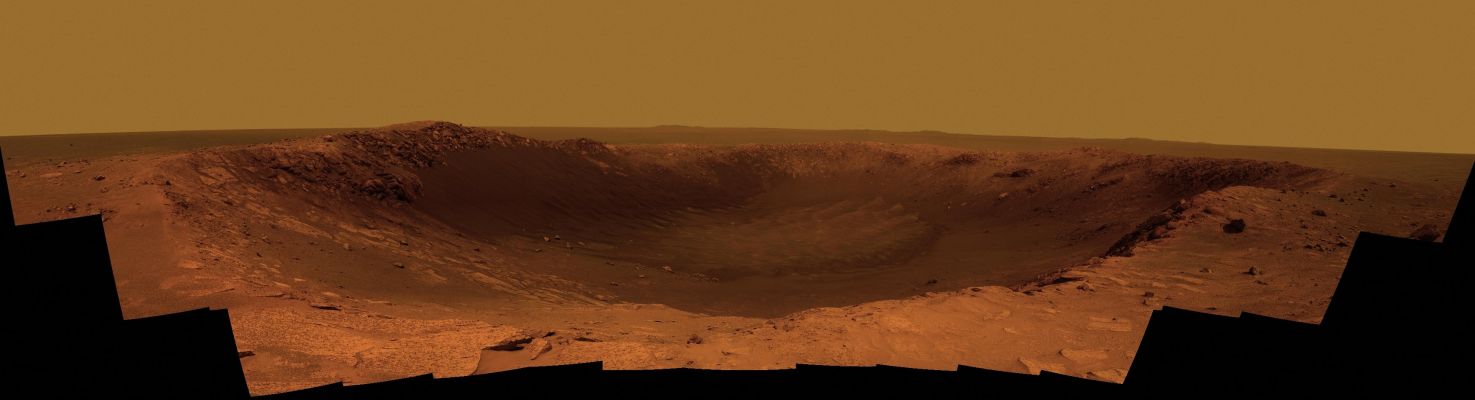
Santa Maria Crater in Natural Colors, according to NASA - Sol 2453 and 2454 (an Image-Mosaic by NASA/JPL-Caltech - Cornell-ASU)
NASA's Mars Exploration Rover Opportunity is spending the Seventh Anniversary of its landing on Mars investigating a Crater called "Santa Maria", which has a diameter about the length of a football field. This scene looks Eastward across the Crater. Portions of the Rim of a much larger Crater, such as Endeavour Crater, appear on the horizon. 

The panorama spans 125 compass degrees, from North/North-West on the left to South/South-West on the right. It has been assembled from multiple frames taken by the PanCam on Opportunity during the 2453rd and 2454th Martian Days, or Soles, of the Rover's work on Mars (such as Dec. 18 and 19, 2010). 

Opportunity landed in the Meridiani Planum Region of Mars on Jan. 24, 2004, Universal Time (Jan. 25, Pacific Time) for a mission originally planned to last for three months. Since that Prime Mission, the Rover has continued to work in bonus-time extended missions. 
Both Opportunity and its twin, Spirit, have made important discoveries about wet environments on ancient Mars that may have been favorable for supporting microbial life.

By mid-January 2011, Opportunity reached a location at the South-Eastern edge of Santa Maria Crater. The Rover Team developed plans for Opportunity to spend a few weeks investigating rocks at that site during Solar Conjunction, a period when communications between Earth and Mars are curtailed because the Sun is almost directly between the two Planets. After completion of its work at Santa Maria, the Rover will resume a long-term trek toward Endeavour.

This view combines images taken through three different PanCam filters admitting light with wavelengths centered at 753 nanometers (Near InfraRed), 535 nanometers (green) and 432 nanometers (violet). This "Natural Color" is the Rover Team's best estimate of what the scene would look like if we were there and able to see it with our own eyes. Seams have been eliminated from the Sky portion of the mosaic to better simulate the vista a person standing on Mars would see.
Parole chiave: Martian Surface - Craters - Santa Maria Crater

Santa Maria Crater in Natural Colors, according to NASA - Sol 2453 and 2454 (an Image-Mosaic by NASA/JPL-Caltech - Cornell-ASU)

NASA's Mars Exploration Rover Opportunity is spending the Seventh Anniversary of its landing on Mars investigating a Crater called "Santa Maria", which has a diameter about the length of a football field. This scene looks Eastward across the Crater. Portions of the Rim of a much larger Crater, such as Endeavour Crater, appear on the horizon.

The panorama spans 125 compass degrees, from North/North-West on the left to South/South-West on the right. It has been assembled from multiple frames taken by the PanCam on Opportunity during the 2453rd and 2454th Martian Days, or Soles, of the Rover's work on Mars (such as Dec. 18 and 19, 2010).

Opportunity landed in the Meridiani Planum Region of Mars on Jan. 24, 2004, Universal Time (Jan. 25, Pacific Time) for a mission originally planned to last for three months. Since that Prime Mission, the Rover has continued to work in bonus-time extended missions.
Both Opportunity and its twin, Spirit, have made important discoveries about wet environments on ancient Mars that may have been favorable for supporting microbial life.

By mid-January 2011, Opportunity reached a location at the South-Eastern edge of Santa Maria Crater. The Rover Team developed plans for Opportunity to spend a few weeks investigating rocks at that site during Solar Conjunction, a period when communications between Earth and Mars are curtailed because the Sun is almost directly between the two Planets. After completion of its work at Santa Maria, the Rover will resume a long-term trek toward Endeavour.

This view combines images taken through three different PanCam filters admitting light with wavelengths centered at 753 nanometers (Near InfraRed), 535 nanometers (green) and 432 nanometers (violet). This "Natural Color" is the Rover Team's best estimate of what the scene would look like if we were there and able to see it with our own eyes. Seams have been eliminated from the Sky portion of the mosaic to better simulate the vista a person standing on Mars would see.

OPP-SOL2453-1P345952751EFFB0J3P2297R2M1.jpg OPP-SOL2453-1P345953004EFFB0J3P2297L2M1.jpg OPP-SOL2453-2454-PIA13794-1.jpg OPP-SOL2453-2454-PIA13795-PCF-LXTT-0.jpg OPP-SOL2453-2454-PIA13795-PCF-LXTT-1.jpg
Informazioni sul file
Nome del file:OPP-SOL2453-2454-PIA13794-1.jpg
Nome album:MareKromium / After One-Thousand Soles...
Valutazione (22 voti):11111(Mostra dettagli)
Parole chiave:Martian / Surface / - / Craters / - / Santa / Maria / Crater
Copyright:NASA/JPL-Caltech/Cornell and Arizona State University and Paolo C. Fienga/Lunexit Team per l'additional process. e la colorizzazione
Dimensione del file:464 KiB
Data di inserimento:Gen 26, 2011
Dimensioni:3500 x 949 pixels
Visualizzato:133 volte
URL:https://www.lunexit.it/gallery/displayimage.php?pid=28209
Preferiti:Aggiungi ai preferiti

Commento 1 a 2 di 2
Pagina: 1

Matteo Fagone   [Gen 28, 2011 at 02:08 PM]
Questa č fra le peggiori e pių fasulle immagini che si potevano immaginare! Come quelle dell'ESA pių o meno...
MareKromium   [Gen 28, 2011 at 07:38 PM]
...peggio. L'incompetenza dell'ESA, in fondo, potrei anche "capirla". Quella della NASA...no. - PCF

Commento 1 a 2 di 2
Pagina: 1


Powered by Coppermine Photo Gallery