|
|
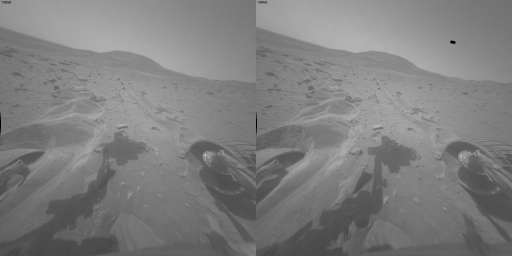
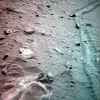
Movements and a Martian "Fly"?!? - Sol 2090 (GIF-Movie; credits: NASA/JPL-Caltech)
|
Caption NASA:"This blink comparison documents very slight forward movement of NASA's Mars Exploration Rover Spirit during a drive on the rover's 2090th Martian Day, or Sol (such as Nov., 19th, 2009).
The two wide-angle views are from the right-side eye of Spirit's Front Hazard-Avoidance Camera (HazCam), one taken on Sol 2088 (Nov. 17) and the other after the drive on Sol 2090. The most obvious change is in the position of the shadow of the Rover Arm (RA), a change unrelated to the Rover's movement during the drive.
The shadow is farther to the left on the "before" (Sol 2088) image than on the "after" (Sol 2090) image.
In the "after" image, Spirit's left-front wheel has become slightly less buried in the soft soil in which the Rover had become embedded about 6 months ago. The right-front wheel, which has not been usable for driving since 2006, has been pushed perceptibly forward by the drive. The amount of forward motion is less than 1% of the distance that would have been covered on firm ground by the amount of wheel rotation commanded in the drive.
The Sol 2090 drive was the second drive commanded after the Rover Team spent months using Earthbound testing and analysis to develop a strategy for attempting to drive Spirit out of this soft-soil site, called "Troy".
Extrication drives are expected to make slow, if any, progress in coming weeks, and the probability of success in escaping from Troy is uncertain".
Nota Lunexit: Spirit, a nostro parere, riuscirà a venir fuori da Troy...
|
|









Segnalazione veloce: http : // www . apcom . net / newscultura / cultura . shtml
la tua domanda - logica ed assolutamente razionale - è anche la mia. La risposta, secondo me, è ovvia: i dati ci sono, ma la NASA - pubblicamente almeno - non li divulga. Qualcosa venne fatta al riguardo da Phoenix, ma sui dati afferenti la luminosità, la temperatura, l'umidità e la pressione proprie del Bacino di Gusev e della Pianura di Meridiani non mi pare che sia stato mai detto nulla di assoluto e di riferibile alla lettura di un apparecchio dedicato (igrometro, barometro o termometro che sia) e presente sui Rover.
Sul fatto che la sabbia di Gusev sia "secca", non so che dire. Certo, "sembra" che sia così, ma io - ormai - ho dubbi un pò su tutto (colpa della NASA, che non parla, o parla dicendo cose ovvie e/o contraddittorie - tipo quelle di cui si tratta nel pezzo segnalato dall'ottima 2di7).
Io credo che la situazione potrebbe essere diversa nelle ore del primo mattino, quando - come la NASA stessa disse, un tre anni e mezzo fa - in alcuni periodi dell'Anno Marziano, si forma sulla superficie di Marte un "velo" di umidità (una "pellicola" - "a film of water droplets" - dissero a Pasadena) o anche all'imbrunire.
Ma poi, come ovvio, non avendo in mano dati certi, ogni cosa che dico potrebbe risolversi in una stupidata e quindi...
Un Saluto e Buon Week-End a Tutti! PCF
Tuttavia, per il sol in questione dobbiamo aspettare circa la metà del 2010 perchè i dati vengano messi a disposizione.
Comunque lascia stare la derivazione dei dati; chiedi direttamente al JPL, chiarendo e definendo il target di cui interessa la temperatura superficiale. Ti risponderanno in poco tempo. - PCF
Questo è il modus operandi che perseguiamo qui, e dunque...procedemus! - PCF
http : // www . nasa . gov / mission_pages / mer / images / mer20091215 . html