Inizio Registrati Login

Elenco album Ultimi arrivi Ultimi commenti Più viste Più votate Preferiti Cerca

L'immagine è stata aggiunta ai preferiti
Inizio > MARS > Curiosity and the Exploration of Gale Crater
Ritorna alla pagina delle miniature FILE 257/260 Torna all'inizio Guarda foto precedente Guarda foto successiva Salta alla fine
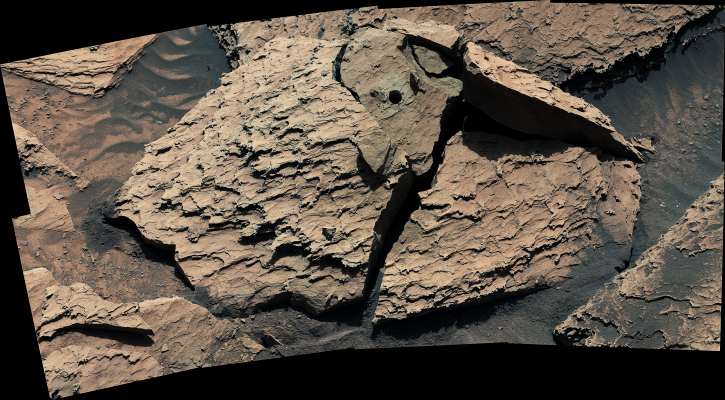
Atacama - Sol 4877 (Credits: NASA/JPL-Caltech)
NASA’s Curiosity Mars rover used its Mast Camera, or Mastcam, to capture this view of a rock nicknamed “Atacama” on May 6, 2026, the 4,877th Martian day, or sol, of the mission. The rock had gotten stuck to the drill on the end of Curiosity’s robotic arm on April 25. Engineers spent several days repositioning the arm and vibrating the drill to try and get the rock loose, finally detaching the rock on May 1.

Atacama is estimated to be 1.5 feet in diameter at its base and 6 inches thick. It would weigh roughly 28.6 pounds (13 kilograms) on Earth (and about a third of that on Mars). The circular hole produced by Curiosity’s drill is visible in the rock.

This mosaic is made up of eight images that were stitched together after being sent back to Earth. The color has been approximately white-balanced to resemble how the scene would appear under daytime lighting conditions on Earth.

Curiosity was built by NASA’s Jet Propulsion Laboratory, which is managed by Caltech in Pasadena, California. JPL leads the mission on behalf of NASA’s Science Mission Directorate in Washington as part of NASA’s Mars Exploration Program portfolio. Malin Space Science Systems in San Diego built and operates Mastcam.
Parole chiave: Martian Surface

Atacama - Sol 4877 (Credits: NASA/JPL-Caltech)

NASA’s Curiosity Mars rover used its Mast Camera, or Mastcam, to capture this view of a rock nicknamed “Atacama” on May 6, 2026, the 4,877th Martian day, or sol, of the mission. The rock had gotten stuck to the drill on the end of Curiosity’s robotic arm on April 25. Engineers spent several days repositioning the arm and vibrating the drill to try and get the rock loose, finally detaching the rock on May 1.

Atacama is estimated to be 1.5 feet in diameter at its base and 6 inches thick. It would weigh roughly 28.6 pounds (13 kilograms) on Earth (and about a third of that on Mars). The circular hole produced by Curiosity’s drill is visible in the rock.

This mosaic is made up of eight images that were stitched together after being sent back to Earth. The color has been approximately white-balanced to resemble how the scene would appear under daytime lighting conditions on Earth.

Curiosity was built by NASA’s Jet Propulsion Laboratory, which is managed by Caltech in Pasadena, California. JPL leads the mission on behalf of NASA’s Science Mission Directorate in Washington as part of NASA’s Mars Exploration Program portfolio. Malin Space Science Systems in San Diego built and operates Mastcam.

SOL4887-NLB_831328705EDR_S1220000NCAM00593M_.jpg SOL4887-PIA26696_figA.png SOL4887-PIA26724.png W-Martian_Clouds-00.gif W-Martian_Clouds-01.gif
Informazioni sul file
Nome del file:SOL4887-PIA26724.png
Nome album:MareKromium / Curiosity and the Exploration of Gale Crater
Valutazione (1 voti):55555(Mostra dettagli)
Parole chiave:Martian / Surface
Copyright:NASA/JPL-Caltech - Curiosity Rover Mission
Dimensione del file:21438 KiB
Data di inserimento:Mag 12, 2026
Dimensioni:4594 x 2533 pixels
Visualizzato:112 volte
URL:https://www.lunexit.it/gallery/displayimage.php?pid=32059
Preferiti:Rimuovi dai preferiti

Commento 1 a 2 di 2
Pagina: 1

MareKromium   [Mag 12, 2026 at 03:31 PM]
La roccia si è pluri-fratturata durante la sua perforazione e, dentro, non pare essere totalmente compatta. Ma potrei sbagliare.
Paolo C. Fienga   [Mag 20, 2026 at 09:57 PM]
Infatti, se lo fosse (piena/totalmente compatta), il frammento centrale prossimo al foro, non sarebbe affondato. Conclusione: la roccia è un "guscio" parzialmente vuoto. Pensateci su...

Commento 1 a 2 di 2
Pagina: 1


Powered by Coppermine Photo Gallery